


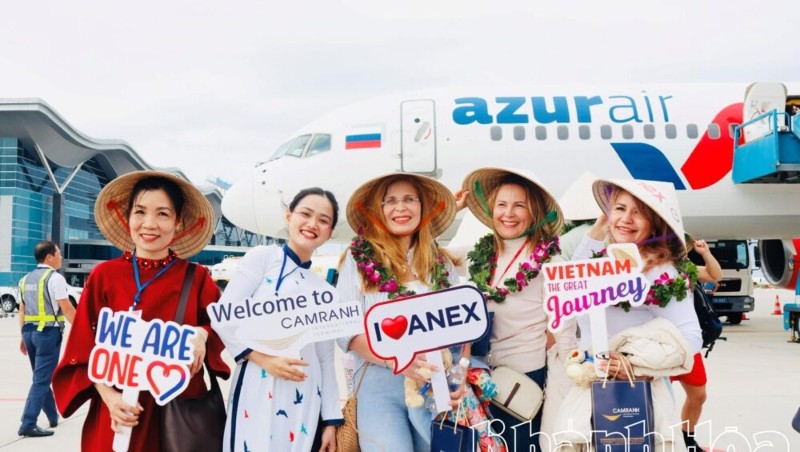
According to Yandex Ads, Vietnam welcomed more than 862,000 Russian speaking visitors this year, as of May 2026, following more than 1.2 million arrivals in 2025. During the first four months of 2026 alone, Da Nang received over 142,000 visitors from Russia and countries in the Commonwealth of Independent States (CIS).
The recovery has been further strengthened by improved air connectivity. In May 2026, Da Nang welcomed its first direct charter flight from Moscow and continues to operate multiple charter services connecting the city with Russia and other CIS markets between April and October. In June, Vietjet Air expanded direct connectivity by launching three new routes between Vietnam and Russia, linking Da Nang with Moscow and Nha Trang with Kazan and Novosibirsk. The new services are expected to further facilitate tourism flows and strengthen travel demand between the two countries.
The renewed momentum, however, also presents a challenge. Many Vietnamese tourism businesses continue to rely on traditional marketing channels or digital platforms that are no longer the preferred choice among Russian consumers.
While Google and Meta dominate many international markets, Russian users tend to rely on domestic platforms such as Yandex to search for information, watch videos, navigate maps and plan their trips. This means Vietnamese tourism businesses need to shift from simply promoting destinations to understanding how Russian travelers search for information and make travel decisions within their own digital ecosystem.
Turning local data into a competitive advantage
According to Yandex Ads, Russian travelers typically spend around 28 days researching before booking flights or accommodation. During this period, they interact with multiple digital touchpoints, including search engines, maps, review platforms, weather applications, video content and recommendation systems. This suggests that travel decisions are often shaped well before a booking is made.
Search data further illustrates this trend. During the fourth quarter of 2025, Russian language searches for Da Nang increased 201% year on year, while searches related to hotels in Vietnam rose 400%. The figures indicate that travel demand begins to emerge during the research stage, long before reservations are made.
Against this backdrop, AdTech platforms powered by AI and built on first party data are becoming increasingly valuable. They enable tourism businesses to identify customer demand early, anticipate consumer behavior and deliver personalized messages throughout every stage of the customer journey.
Speaking to Vietnam Economic Times/VnEconomy, Ms. Thu Nguyen, Business Development Director of Yandex Ads Vietnam, said businesses seeking to attract Russian travelers must first understand how they search for information and plan their trips.
"Success is not about reaching more people. It is about identifying the right audience from the earliest stage, accurately understanding their needs and delivering the right message at every touchpoint throughout the travel journey," she said.
Leveraging an ecosystem of more than 90 digital services and extensive first party behavioral data, Yandex Ads enables Vietnamese businesses not only to identify consumers interested in Vietnam but also to determine when travel demand begins to emerge and how it evolves throughout the decision making process.
The effectiveness of this data driven approach has already been demonstrated in Vietnam. During a tourism promotion campaign jointly launched by the Da Nang Tourism Promotion Center and Yandex Ads in May 2026, the city's official tourism portal recorded more than 1.1 million interactions and 424,000 page views within just one month.
Russian speaking markets, including Russia, Belarus, Kazakhstan and Uzbekistan, accounted for more than half of the portal's total traffic, with Russia alone representing 52 per cent of active users.
AdTech solutions have also delivered tangible commercial results. According to Yandex, an international five star hotel and resort operating in Vietnam achieved a 2.33 fold increase in conversion rates and a 1.98 fold improvement in return on investment (ROI) compared with the previous year after launching campaigns on the platform.
Notably, Yandex data shows that nearly half of Russian speaking users planning trips to Vietnam belong to high income and affluent consumer groups, highlighting that the market offers not only significant scale but also strong spending power.
Vietnam's AdTech market enters a new phase
According to Yandex Ads, Vietnam's AdTech market is entering a new phase of rapid transformation. Rather than simply catching up with more developed markets, the country is demonstrating remarkable adaptability and one of the fastest growth rates in the region.
Vietnam's digital advertising market is projected to expand from approximately $1.3 billion to $1.4 billion in 2025 to nearly $2.9 billion by 2030. Total digital advertising spending is expected to reach $5.4 billion in 2026 and exceed $7 billion by 2029, making Vietnam one of Southeast Asia's fastest growing digital advertising markets.
Vietnam currently has around 85 million to 86 million internet users, equivalent to an internet penetration rate of approximately 84%, along with nearly 79 million social media users. With a median age of around 33, the country has one of the region's most digitally engaged populations.
AI adoption is also accelerating. The proportion of businesses using AI increased from 21 per cent to 23.5 per cent in 2025, while approximately 78 per cent of internet users have interacted with AI powered platforms. Within ecommerce, AI adoption has reached around 42 per cent, exceeding levels in several regional markets, including Singapore and Thailand.
Globally, AI is reshaping the advertising industry by shifting it away from traditional audience targeting toward demand forecasting and real time personalized customer experiences.
According to Echo Lu, Founder and Chief Executive Officer of Tigerobo Tech, nearly every core advertising function, from content creation and audience targeting to automated media buying and data analytics, is now supported by AI.
Meanwhile, Hazem Karkoutly, Chief Executive Officer of Adbreeze, said AI has been widely adopted across the Middle East to analyze local markets, generate multilingual content and optimize advertising campaigns in real time. However, he noted that technology alone cannot fully unlock its potential in markets where success depends on a deep understanding of local culture and consumer behavior.
Data from Yandex Ads shows that AI technologies improved the overall effectiveness of its advertising ecosystem by 38 per cent in 2025. Today, 82 per cent of advertising budgets on Yandex Direct are optimized using AI, while 90 per cent of marketers rely on AI to build, optimize and analyze campaigns.
According to Yandex Ads Vietnam, AI is also creating a more level playing field for small and medium sized enterprises seeking to expand internationally.
"AI is helping businesses with limited resources compete more effectively in international markets. For the tourism industry, it enables brands to identify potential customers earlier, personalize messages throughout the travel discovery journey and improve conversion rates without proportionally increasing customer acquisition costs," the company said.
Ultimately, the future of tourism advertising is not about displaying more advertisements. It is about delivering the right message at the precise moment when travel demand begins to emerge. As AI continues to reshape the global advertising landscape, the ability to predict demand and personalize customer experiences will become a critical competitive advantage, enabling Vietnamese tourism businesses to better capture the growing Russian outbound market and other international visitor segments with distinctive digital behaviors.





 Google translate