


As global electricity demand continues to grow while countries seek to strengthen energy security and reduce greenhouse gas emissions, nuclear energy is experiencing a strong resurgence. With its ability to provide reliable, large-scale baseload power with near-zero carbon emissions, nuclear power is increasingly recognized as a key pillar of the global energy transition.
Amid this nuclear renaissance, Canada is widely regarded as one of the world's leading nations in civilian nuclear technology. At the heart of this ecosystem is AtkinsRéalis, a Canadian engineering, project management, and nuclear technology company that serves as the developer and commercial steward of CANDU (Canada Deuterium Uranium) reactor technology.
One of the distinguishing features of CANDU technology is its ability to operate using natural uranium rather than enriched uranium, as required by most conventional reactor designs. This provides countries with greater fuel flexibility, enhanced energy security, and reduced dependence on enrichment services. CANDU reactors can also be refueled while operating, allowing them to achieve some of the highest capacity factors in the nuclear industry.
Beyond generating clean electricity, CANDU reactors play an important role in the production of medical isotopes, including Cobalt-60, which is widely used in cancer treatment and the sterilization of medical equipment around the world.
During her visit to Vietnam, Dr. Sara Supa-Amornkul, Business Development Director at Candu Energy Inc., an AtkinsRéalis company, spoke with Vietnam Economic Times/VnEconomy about global trends in nuclear energy, the competitive advantages of CANDU technology, and the potential for deeper cooperation between Canada and Vietnam in clean energy development, workforce training, and the long-term growth of a domestic nuclear industry.
The following is the full interview.
Dr. Sara, Thank you for joining Vietnam Economic Times. Could you briefly introduce yourself and AtkinsRéalis' role in the global nuclear industry?
Thank you for having me today. My name is Sara Supa- Amornkul, and I am the Senior Business Development Director at Candu Energy, a subsidiary of AtkinsRéalis. We are one of the world's leading companies in nuclear technology and nuclear project development.
What is the main purpose of your visit to Vietnam at this important stage of the country's energy transition?
As the global nuclear renaissance gains momentum, Canada and our company are looking to explore opportunities internationally, particularly in Southeast Asia, where we see tremendous potential for collaboration and nuclear industry development.
Vietnam has always been one of the most important countries in the region. That is why I am here to explore opportunities and determine how Canadian nuclear technology can contribute to Vietnam’s nuclear energy development in this new era.
What makes CANDU technology different from other reactor technologies currently available in the global market? What are the key advantages of CANDU reactors in terms of safety, reliability, fuel flexibility, and lifecycle costs?
I am glad you asked that question because CANDU reactors are truly unique. We are the only reactor technology in the world that uses natural uranium, or unenriched uranium.
This gives countries greater energy independence because they do not need to rely on uranium enrichment services when it comes to fuel supply.
Another important feature is that CANDU reactors can produce medical isotopes during operation. This means countries can achieve not only energy security but also greater medical security. During the COVID-19 pandemic and other geopolitical disruptions, many countries experienced supply chain interruptions that affected access to critical medical isotopes, especially for cancer treatment.
With a CANDU reactor, those isotopes can be produced domestically.
In addition, CANDU reactors have one of the highest capacity factors in the industry above 90 percent because they can be refueled online without shutting down the reactor. We are the only technology that offers this capability.
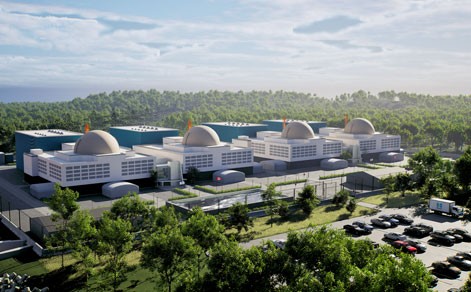
Our newest reactor designs also incorporate modular construction approaches, allowing large nuclear facilities to benefit from many of the efficiencies associated with modular deployment.
Beyond supplying reactor technology, what kind of long-term partnership does AtkinsRéalis envision with Vietnam? How important are workforce development and knowledge transfer in your cooperation model with Vietnam?
I would like to answer this question from a personal perspective. I come from Thailand. I was a Thai student who went to Canada to pursue my Master's degree and PhD. Today, I travel around the world representing Canadian nuclear technology.
My own journey is an example of how Canada collaborates with people from other countries. It did not matter that I was not born in Canada. I was given the opportunity to contribute and represent Canadian technology globally. This is what true collaboration looks like.
Canada and AtkinsRéalis are committed to helping Vietnam develop its workforce and build long-term domestic capabilities so that the country can successfully support and sustain its own nuclear industry for generations to come.
Nuclear power projects require significant investment. How can Canada and AtkinsRéalis support financing and project implementation in Vietnam?
CANDU technology ultimately belongs to the Government of Canada. AtkinsRéalis has the rights to develop and build CANDU reactors, while the intellectual property remains under Canadian ownership.
When we undertake international projects, we typically form consortia involving partners from multiple countries because these are large-scale projects that require broad collaboration.
In many cases, export credit agencies from participating countries also become involved and can provide support in project financing and risk mitigation.
What lessons from successful CANDU projects in countries such as Romania, South Korea, and China could be valuable for Vietnam?
One of the most important aspects of large infrastructure projects is financing.
Financing depends heavily on investor confidence. Through decades of experience around the world, CANDU technology has built a reputation for delivering projects on time and on budget.
This is extremely important for investors and lenders because projects that are completed as planned generally have lower financing risks and lower borrowing costs.
Our global experience has helped us become a stronger technology provider and project developer, and those lessons can certainly benefit future projects in Vietnam.
What message would you like to send to Vietnamese policymakers as they evaluate different nuclear technologies? There is strong international competition among nuclear technology suppliers. Why should Vietnam choose Canada's CANDU technology over other available options?
One of the major concerns around the world today is geopolitical uncertainty. Conflicts and geopolitical tensions can significantly affect energy prices and energy security.
As a result, every country wants greater control over its electricity supply and costs.
This is where CANDU technology offers a unique advantage. Because CANDU reactors use natural uranium, they are not dependent on uranium enrichment services.
Today, only a limited number of countries operate uranium enrichment facilities. If access to enrichment services becomes restricted for political or commercial reasons, countries that depend entirely on enriched fuel could face significant challenges.
Vietnam is already moving forward with nuclear development, and diversification is important. If one project relies on enriched uranium, another project based on natural uranium technology could provide additional energy security and resilience. From my perspective, this diversification would strengthen Vietnam’s long-term energy independence and reduce exposure to external supply risks.
Finally, what is your vision for the future of Vietnam-Canada cooperation in clean energy and nuclear technology?
People often say that a nuclear project is like a marriage it is a long-term commitment and a marathon rather than a sprint.
With refurbishment, a CANDU reactor can operate for close to 100 years. Therefore, it is important to choose a partner that is reliable, trustworthy, and easy to work with over the long term.
I often use my own experience as an example. As someone born outside Canada who was given the opportunity to grow and represent Canadian technology globally, I believe successful partnerships are built on mutual respect, equal opportunity, and trust.
That is the kind of long-term relationship Canada hopes to build with Vietnam in the field of clean energy and nuclear technology.
Thank you for sharing your valuable insights. We wish Candu Energy every success in Vietnam.
Thank you very much. It has been my pleasure.




 Google translate