


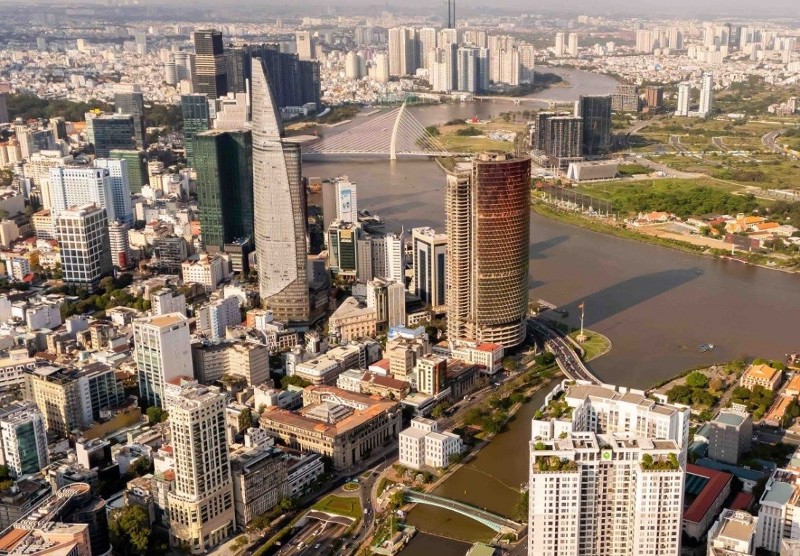
Ho Chi Minh City is shifting its smart city development focus from isolated technological applications to data-driven governance. In this new approach, urban planning is identified as the "spatial framework" to connect data across sectors, support forecasting, and enhance the quality of decision-making.
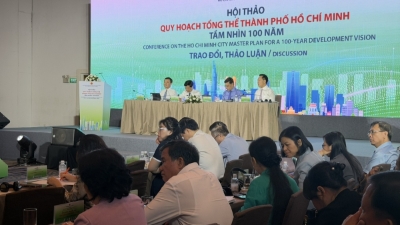
At a recent workshop titled "Solutions for Building and Developing a Smart City in Ho Chi Minh City," Vice Chairman of the City People’s Committee, Mr. Nguyen Manh Cuong, announced that the city has issued Decision No. 4714/QD-UBND that approved the Smart City Development Project for the 2026–2030 period, with a vision toward 2045.
Among the nine core principles identified by the project, the most notable is the order of priority: placing citizens and businesses at the center; using data as the foundation; ensuring interconnection, integration, and shared usage; guaranteeing information security and privacy; implementing roadmaps consistent with available resources; and maintaining principles of openness and flexibility to avoid technology lock-in.
This mindset prioritizes data and governance capacity over technology—a distinct departure from many previous smart city projects that often began with the question of which platforms or systems to purchase.
Agreeing with this approach, Director of the Urban Development Department under the Ministry of Construction, Mr. Tran Quoc Thai, suggested that HCMC should promptly select a shortlist of high-priority urban "problems" that have a significant impact.
For each problem, the city must clearly define baseline indicators, quantitative targets, beneficiaries, input data, leading agencies, life-cycle costs, and post-investment operational mechanisms. Priority areas could include transportation and logistics; flooding, drainage, and the environment; urban planning, construction, and asset management; as well as healthcare, social welfare, and urban safety, said Mr. Thai.
"Technological solutions should only be selected or designed after the problem to be solved has been clearly defined, rather than having a technological product first and then looking for a problem to apply it to," he emphasized.
The Ministry of Construction representative also suggested that HCMC establish a pilot mechanism for testing before scaling up, noting that effective models could then be applied to other localities.
In a presentation titled "The Future of HCMC's Smart City," Deputy Director of the HCMC Department of Planning and Architecture, Mr. Duong Thao Hien, stated that the city aims to develop three core capabilities:
Sense correctly: having reliable data on urban space, infrastructure, residents, businesses, and community capacity.
Understand correctly: connecting data for analysis, simulation, and forecasting.
Act correctly: turning analytical results into coordinated decisions and actions, with designated accountability and measurable performance indicators.
To operate these three capabilities, the Department of Planning and Architecture identified four pillars: unified digital governance; a central urban data platform; continuous data management (as a routine task); and deployment based on scenarios focused on high-impact issues.




 Google translate