


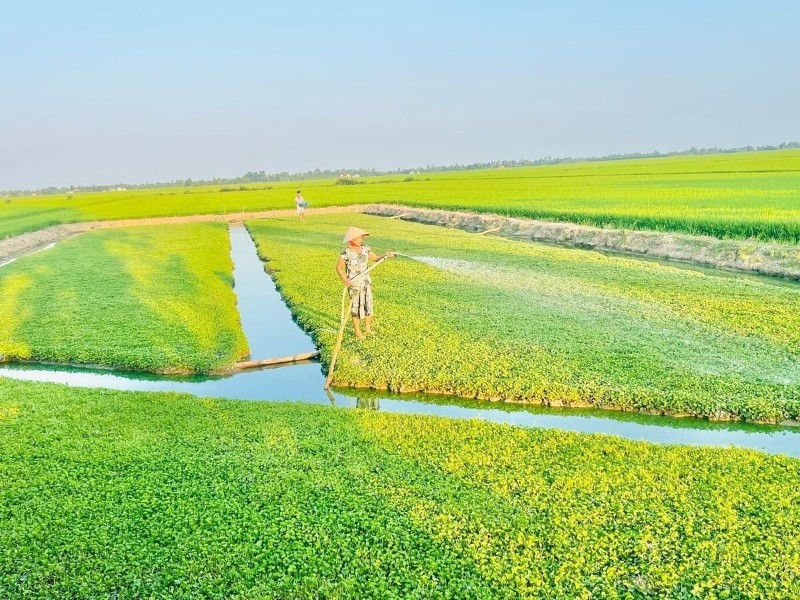
The Ministry of Agriculture and Environment has issued an official document to the People's Committees of provinces and cities across the Central, Southeast, and Mekong Delta regions of Vietnam, directing the implementation of response measures against drought, water shortages, and saltwater intrusion caused by the 2026-2027 El Niño phenomenon.
According to meteorological forecasts, El Niño is expected to maintain "strong to very strong" intensity from September to November 2026 with a 100% probability (of which 93% is projected to reach "very strong" levels). Between October and December 2026, the probability of the phenomenon reaching peak intensity hits 95%. This severe status is expected to persist into early 2027, with a 93% probability of remaining strong to very strong from December 2026 through February 2027.
The ministry’s dispatch emphasizes the need for proactive measures to tackle saltwater intrusion in the Mekong Delta, as well as drought and forest fires in the South Central and Southeast regions.
Local authorities are required to develop and update response plans for the 2026-2027 dry season based on "very high-risk" scenarios. These scenarios anticipate saltwater intrusion in the Mekong Delta to be as severe as the 2019-2020 period, while drought and water shortages in other regions may mirror the historic 2014-2016 crisis. The plans must detail the potential impacts on agricultural production, rural domestic water supplies, forest fires, aquaculture, and livestock.
The ministry urged localities to optimize water storage in irrigation and hydroelectric reservoirs during the 2026 rainy season to maximize capacity. However, this must be balanced with ensuring the safety of dams, reservoirs, and downstream areas while remaining vigilant against extreme rain and flood events.
Furthermore, localities must review and rearrange production schedules. Sowing dates should be adjusted to ensure that the periods when crops require the most water do not coincide with peak drought or saltwater intrusion.
The forecast outlines significant risks across several key regions.
Mekong Delta: Saltwater intrusion is expected to peak between January and April 2027. Under a "high-risk" scenario, 64,000 ha of Winter-Spring rice, 80,000 ha of rice-shrimp farming, and 19,000 ha of fruit trees could be affected. In a "very high-risk" scenario, these figures rise to 85,800 ha, 120,000 ha, and 45,000 ha, respectively.
North Central and South Central Coast: In the 2026-2027 Winter-Spring crop, 12,000 to 25,000 ha are at risk under the high-risk scenario, potentially doubling to 50,000 ha in the worst case. For the 2027 Summer-Autumn crop, the affected area could surge to between 90,000 and 120,000 ha.
Central Highlands and Southeast: The Winter-Spring crop faces potential damage to 42,000–75,000 ha (high risk) or up to 135,000–190,000 ha (very high risk), primarily impacting perennial industrial crops.
Domestic Water Supply: Approximately 82,240 households are at risk of water shortages under the high-risk scenario. This number could jump to 254,570 households in the very high-risk scenario, concentrated mostly in the Mekong Delta, North Central, and South Central Coast regions.





 Google translate