


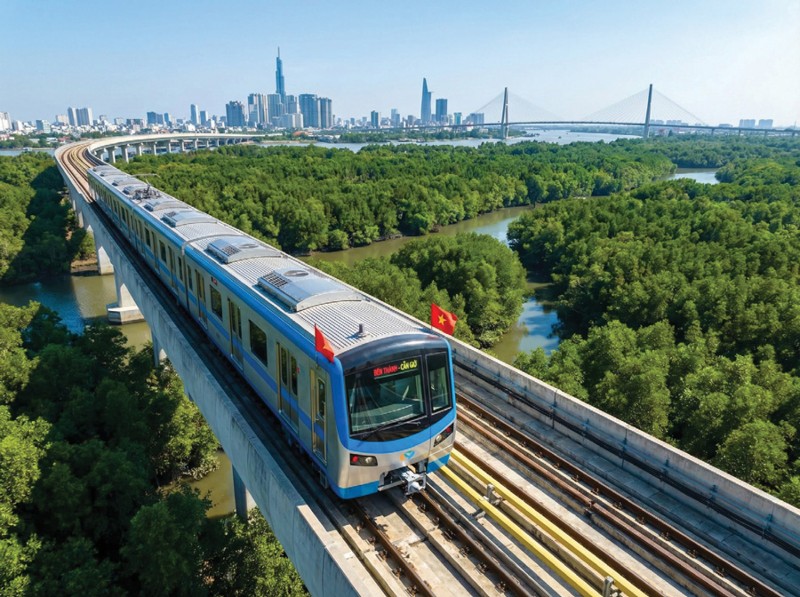
Based on international experience, how are large-scale metro development programs typically financed? What roles do public budgets, loans, bonds, land-based financing, and private capital play?
Large-scale metro programs are typically financed through a combination of financing - the upfront capital needed to build infrastructure, funding, and long-term revenue streams that support operations and repay investment. This reflects the nature of metro systems, which require significant capital investment upfront while generating economic and social returns over decades.
Construction is generally financed through public resources, including government budgets, Official Development Assistance (ODA), concessional loans, and, in some cases, government or green bonds. These are complemented by private investment and public-private partnerships (PPPs), particularly for commercially-viable assets such as station retail, depots, real estate developments, and Transit-Oriented Development (TOD). The key is not whether the public or private sector leads, but how projects are structured so the two can complement one another.

Long-term funding typically combines public subsidies, fare revenue, non-fare income, such as advertising, station naming rights, and commercial leasing, and land value capture mechanisms. Since fare revenue rarely covers operating and maintenance costs, diversified income streams are essential. Cities such as Hong Kong (China) and Singapore have demonstrated how property development and land value capture can underpin the financial sustainability of metro systems.
Vietnam is beginning to move in this direction through National Assembly Resolution No. 188/2025/QH15, which provides a legal basis for measures including higher floor area ratios (FAR), infrastructure betterment charges, and other land value capture tools.
Ultimately, metro systems cannot rely on a single source of financing. The public sector should provide the foundation, supported by long-term capital, while a strong legal and policy framework encourages private investment and unlocks commercial and land-based revenues that strengthen long-term financial sustainability.
What should Vietnam’s policy priorities be for mobilizing and managing resources for metro development?
First, growing private sector interest in urban rail should be viewed as a positive sign, but participation must be supported by well-designed project structures and effective governance.
Major Vietnamese groups, including Vingroup / VinSpeed, THACO, Becamex, Sovico, and Masterise, are becoming increasingly involved in metro development in Hanoi and Ho Chi Minh City. They can contribute implementation capacity, commercial discipline, and additional investment. However, international experience shows that private capital delivers the best outcomes only when projects have clear structures, balanced risk-sharing arrangements, realistic revenue assumptions, and strong public sector oversight.
Second, policymakers should distinguish clearly between financing and funding. Successful metro systems are designed around a balanced mix of both rather than depending too heavily on any single source.
Third, metro infrastructure should be viewed as a platform for creating economic value rather than simply a transport asset. Hong Kong (China)’s MTR “Rail + Property” model and Shenzhen Metro both illustrate how integrating rail investment with urban development can generate substantial property and commercial value.
For Vietnam, the lesson is that metro investment creates not only mobility benefits but also higher land values and new commercial opportunities. Those gains should be captured and reinvested into the system through appropriate legal and financial mechanisms. Otherwise, much of the value will accrue to surrounding developments while the public sector continues to bear most of the investment cost.
Finally, Vietnam should use carefully selected pilot projects to test TOD, station-area development, and PPP models. These pilots can help refine legal frameworks, revenue models, risk-sharing arrangements, and institutional coordination while gradually building investor confidence.
Under current master plans, Hanoi and Ho Chi Minh City will need to mobilize an estimated $214 billion to $241 billion to develop more than 2,000 km of metro lines. The greatest challenge, however, is not simply securing sufficient capital, but designing a financing framework that enables the system to continue attracting investment, operate efficiently, and maintain long-term fiscal sustainability.
More broadly, metro development should be planned at the network level rather than project-by-project. An integrated legal, financial, and institutional framework is needed so that public investment, private capital, land value capture, and long-term revenue streams reinforce one another.
Applying those principles to Hanoi, what should guide the city’s financing strategy?
Hanoi’s financing framework should rest on five core principles. First, the city should establish a layered financial structure instead of relying primarily on fares or government subsidies. Different revenue streams should serve different purposes.
Second, the public sector should continue to underpin the system, particularly for land acquisition, site clearance, and core infrastructure that is difficult to finance commercially. At the same time, Hanoi should begin implementing land value capture measures permitted under Resolution No. 188, including higher FAR and infrastructure betterment charges, allowing the city to test and refine these mechanisms while generating new revenue.
Third, the metro should be integrated with broader urban development. Financing should be aligned with TOD policies, land-use planning, transport management, climate objectives, and gender equality, disability, and social inclusion (GEDSI).
Fourth, PPPs should be applied selectively. Core infrastructure, including tunnels, viaducts, rail tracks, and major technical systems, is generally better suited to public funding, ODA, or concessional finance because of its high upfront costs and limited commercial returns. By contrast, station retail, depots, real estate, and TOD projects are typically more attractive to private investors because they offer clearer revenue opportunities.
Fifth, private investment depends on credible and transparent risk-sharing. Investors are unlikely to commit significant capital unless risks are allocated appropriately. Policy and land-related risks that fall within the public sector’s responsibility should not be transferred entirely to private investors. PPPs should therefore be seen not as a substitute for public funding but as a targeted tool for mobilizing capital and expertise where market conditions support private participation.
Ultimately, Hanoi’s challenge is not simply securing enough funding to build metro lines but creating a financing framework that enables the system to attract investment, operate efficiently, and remain fiscally-sustainable over the long term. Resource mobilization should therefore form part of a broader urban development strategy linking transport investment, land value capture, and institutional reform.
As Hanoi and Ho Chi Minh City accelerate multiple metro projects simultaneously, what risks are they likely to face, and how should they manage them?
The greatest financial challenge is not the scale of individual projects but the cumulative pressure they place on fiscal capacity, implementation capability, and long-term public finances. The answer is not to slow metro development but to manage acceleration through an integrated program-wide approach.
The first risk is the concentration of capital requirements. Hanoi plans an 18-line network covering roughly 979 km with estimated investment of $110 billion to $137 billion, while Ho Chi Minh City’s long-term vision includes 27 lines totaling around 1,024 km and requiring about $104 billion. Launching multiple lines simultaneously could strain public finances and crowd out other investment priorities if financing is not carefully phased. Many cities mitigate this by prioritizing strategic corridors and matching financing instruments to different project stages rather than relying on a single source.
The second risk is cost overruns and delays across the project portfolio. Simultaneous construction increases pressure on land acquisition, approvals, contractor capacity, supply chains, and project management. Experience from metro projects in Bengaluru and Mumbai in India shows that land clearance, utility relocation, procurement, coordination across contracts, and scope changes require rigorous management before and during construction. The lesson is not to reduce ambition but to strengthen project preparation, implementation capacity, and interagency coordination.
The third risk is failing to capture the land value created by metro investment. If TOD and metro planning proceed separately, cities may lose the opportunity to recycle rising land values back into the transport system. Many successful metro cities therefore integrate transport planning, station-area development, and land value capture from the outset, allowing the economic gains generated by metro investment to help finance future expansion.
Ultimately, the question is not whether Hanoi and Ho Chi Minh City should accelerate metro development, but how they can do so sustainably. Metro expansion should be managed as an integrated program combining finance, implementation, and urban development, rather than as a collection of individual construction projects.



 Google translate