


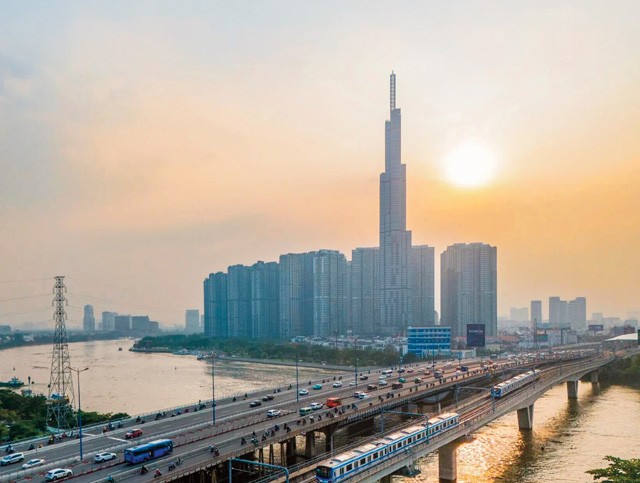
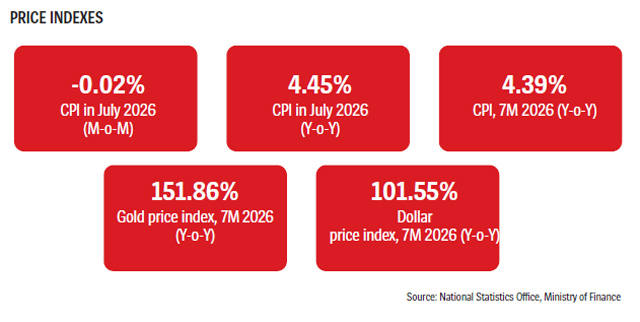
The first seven months of 2026 brought encouraging momentum to Vietnam’s economy. Industrial production continued to recover, while public investment and FDI accelerated. International merchandise trade remained robust, inflation stayed within the government’s target range, and tourism continued its strong rebound, with 13.9 million international arrivals, up 13.8 per cent year-on-year and supporting consumer spending and the services sector.
However, headline growth figures alone do not fully capture the nature of the recovery. Beneath the positive momentum, new structural constraints are emerging. Domestic demand has recovered more slowly than expected, the trade deficit has widened, foreign-invested enterprises (FIEs) continue to dominate exports, mergers and acquisitions (M&As) by foreign investors are increasing, and inflationary pressures, while not yet pronounced, are gradually building.
As a result, the key policy challenge for the remaining five months of the year is no longer simply sustaining growth. It is to convert the current recovery into new sources of long-term growth while strengthening the economy’s resilience and improving the quality of development over the medium and long term.
IIP a major bright spot
Industrial production remained one of the brightest elements of Vietnam’s economy during the first seven months of 2026. The Index of Industrial Production (IIP) rose 11.4 per cent year-on-year, while manufacturing grew 12 per cent, reinforcing its role as the primary engine of economic growth. The figures suggest that production capacity is steadily recovering after a prolonged period of global economic disruption.
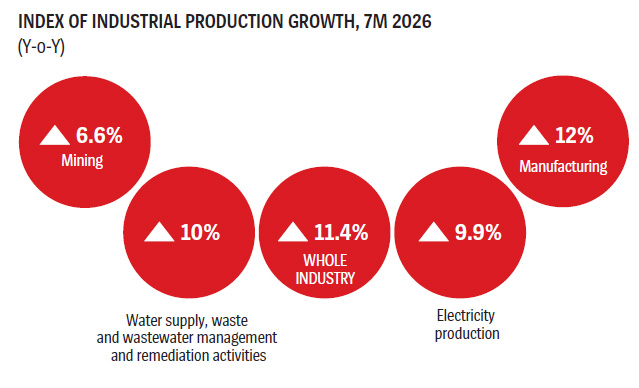
Notably, industrial output continued to expand despite persistent risks from higher energy prices and logistics costs and an uncertain global trade environment, highlighting the manufacturing sector’s growing resilience and adaptability.
Yet the pace of growth tells only part of the story, as the quality of the recovery also warrants close attention. Growth continues to be driven largely by foreign-invested manufacturers and export-oriented industries, leaving domestic production highly exposed to shifts in global demand and international supply chains.
Against a backdrop of continued global uncertainty, sustained industrial growth is a positive sign. But turning this momentum into a durable foundation for long-term growth will require more than expanding production capacity. Policy priorities should focus on strengthening domestic manufacturers, developing support industries, and increasing the local value-added content of Vietnamese products.
Industrial production is clearly recovering, but only stronger domestic production capabilities can transform that recovery into sustainable long-term growth.
While the IIP measures production performance, the Purchasing Managers’ Index (PMI) offers a clearer picture of the quality and outlook of the recovery. The PMI’s performance during the first seven months of the year therefore provides deeper insight into the health of Vietnam’s manufacturing sector.
PMI on the rebound
After falling in April and June, the PMI climbed to 52.9 in July 2026; its highest reading since March and the seventh consecutive month it has been above the 50-point threshold. The increase indicates continued expansion in manufacturing activity and gradually improving business confidence.
Production, new orders, and export orders all rose for a third consecutive month. At the same time, input cost pressures and output price inflation eased to their lowest levels in around ten months, while supply chain delays were significantly shortened. Together, these developments created a more favorable operating environment for manufacturers in the short term.
Business sentiment also improved, though it remained below levels seen before the outbreak of conflict in the Middle East, suggesting that companies continue to exercise caution amid global economic uncertainty, volatile energy prices, and a concerning outlook for international trade.
Notably, the PMI improved despite sluggish domestic consumption and continued uncertainty in export markets. As a result, the manufacturing sector’s outlook remains heavily dependent on export demand and the stability of global supply chains.
These trends suggest that while the PMI is sending encouraging signals, it is still too early to conclude that the recovery is firmly established. Alongside efforts to help businesses expand into overseas markets, policymakers will also need to strengthen domestic demand to provide a more stable foundation for industrial growth.
The PMI points to a manufacturing recovery, but it also underscores that the durability of that recovery will ultimately depend on the economy’s ability to strengthen its domestic growth drivers.
Business formation rises
Vietnam’s business landscape sent mixed signals during the first seven months of 2026. Entrepreneurial confidence and investment sentiment continued to improve, yet the resilience of the business sector remains far from secure.
During the period, 187,200 businesses entered the market, including 125,900 newly-established enterprises and 61,300 businesses resuming operations. On average, more than 26,000 businesses entered the market each month. The figures reflect continued improvements in the business environment, administrative reform, and growing confidence in the economy’s recovery prospects.
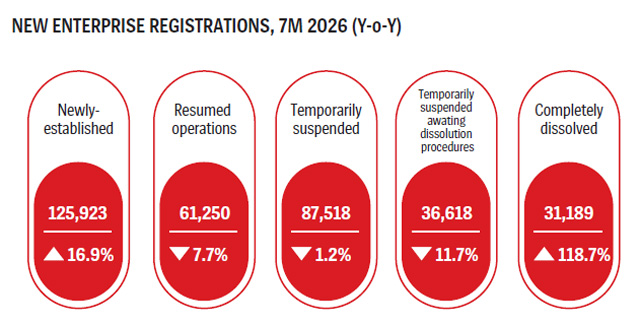
However, the picture is less encouraging when business exits are taken into account. Over the same period, 155,300 businesses left the market, equivalent to some 83 per cent of new market entrants. In July alone, the number of businesses exiting exceeded those entering the market, reversing the improving trend seen over the previous several months.
Most business closures were concentrated in the services sector, which depends heavily on domestic consumer spending. Nearly 73 per cent of temporarily-suspended businesses and more than 78 per cent of completed dissolutions were service-sector firms. This suggests that while domestic demand is recovering, it remains too weak to provide a stable foundation for business growth.
New business formation also remains concentrated in small-scale service enterprises. While this reflects improving entrepreneurial activity, it also underscores the need to improve business quality by encouraging investment in manufacturing, support industries, and innovation - sectors that generate higher value-added and strengthen the economy’s productive capacity.
The economy needs more than a growing number of new businesses. It needs businesses that can survive, expand, and grow alongside the economy. That is the true measure of a healthy business sector. Entering the market reflects confidence; staying in the market reflects economic strength.
If businesses represent the economy’s productive capacity, domestic consumption reflects the strength of market demand. It is also a key determinant of sustainable growth at a time of continued global uncertainty.
Consumption in recovery
Domestic demand is recovering, but not yet at a pace that would allow it to become a major engine of economic growth.
Retail sales of goods and consumer services rose 7.5 per cent year-on-year during the first seven months of 2026; 0.1 percentage points higher than in the same period of 2025 and an improvement against the first half of the year. The increase suggests household consumption is gradually strengthening alongside the recovery in production, business activity, and the labor market.
A standout performer was tourism. Vietnam welcomed a record 13.9 million international visitors during the first seven months of the year, up 13.8 per cent year-on-year. The surge generated additional demand for retail, accommodation, transportation, food services, and other consumer-facing industries, helping support overall consumption.
However, excluding the boost from international tourism, household spending has recovered only gradually. This is reflected in the continued difficulties facing many service sector businesses and the persistently high number of enterprises exiting the market.
The National Statistics Office’s business survey also found that 47 per cent of businesses still consider domestic market demand to be weak.
With exports facing growing uncertainty amid global economic headwinds, sluggish domestic demand means the economy still lacks a sufficiently strong internal growth engine. This is why efforts to stimulate consumption should extend beyond short-term demand support. Policy should instead focus on raising real household incomes, creating sustainable employment, anchoring inflation expectations, and strengthening consumer confidence.
Sustainable high growth cannot rely solely on exports and investment. As domestic consumption becomes a stronger driver of growth, the economy’s resilience to external shocks will improve significantly.
Consumption reflects not only today’s purchasing power but also public confidence in the economy’s future.
International trade expands
International trade remained a key driver of economic growth during the first seven months of 2026. However, trade volumes are expanding faster than trade quality, raising new questions about Vietnam’s development model.
Total trade reached $659.58 billion during the period, up 28.1 per cent year-on-year. Exports increased 21.7 per cent, while imports surged 34.8 per cent, shifting Vietnam from a trade surplus in the same period last year to a trade deficit of $20.52 billion.
At first glance, the rapid expansion of trade appears encouraging. A closer look at its composition, however, reveals several structural concerns. FIEs continued to dominate exports, accounting for 80.1 per cent of total export turnover, while exports by domestic firms grew just 5.8 per cent. This suggests that Vietnamese companies are making only gradual progress in integrating into global value chains.
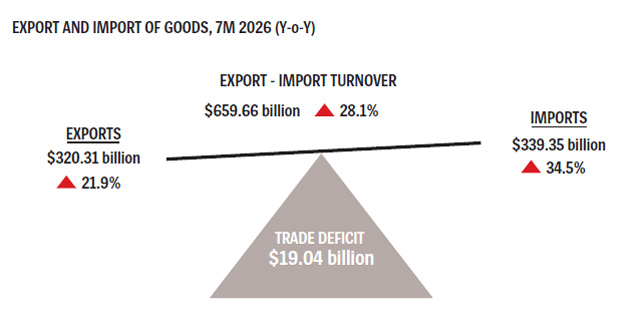
Trade has also become increasingly concentrated in a handful of high-tech product groups, particularly electronics, computers, and components. These accounted for 26.65 per cent of total exports, while representing nearly 40 per cent of total imports and generating a trade deficit of $50.6 billion during the first seven months of the year. The figures highlight the economy’s continued dependence on imported inputs and components, limiting the amount of value-added created domestically.
Another indicator also deserves attention: the apparent deterioration in the terms of trade. When export prices rise more slowly than import prices, the economy must export a greater volume of goods to purchase the same quantity of imports. In other words, trade volumes may continue to grow while the real national income generated from trade declines. This should be viewed as an indicator of trade quality rather than simply a short-term market fluctuation.
Against this backdrop, trade policy should move beyond expanding export volumes toward increasing domestic value-added, developing support industries, diversifying export markets, and strengthening the competitiveness of Vietnamese businesses within global supply chains.
Trade turnover reflects the openness of the economy, but the domestic value-added embedded in exports is the true measure of growth quality.
If trade reflects the economy’s ability to access markets, investment determines its future productive capacity. The key challenge, therefore, is not simply attracting more capital, but ensuring higher-quality investment with stronger spillover effects across the broader economy.
Investment gathers pace
Yet as investment volumes continued to expand in the first seven months, improving the quality and efficiency of capital flows is becoming an increasingly strategic priority.
Public investment disbursement outpaced the same period last year, while work accelerated on major infrastructure projects, expanding the country’s infrastructure capacity and creating additional room for long-term growth. The progress also reflects the government’s determined efforts to remove bottlenecks in investment procedures, land clearance, and delayed projects.
Alongside public investment, FDI continued to strengthen. FDI disbursement reached $15.2 billion, the highest seven-month total in five years, while both newly-registered and additional capital rose sharply, underscoring foreign investors’ confidence in Vietnam’s investment environment.
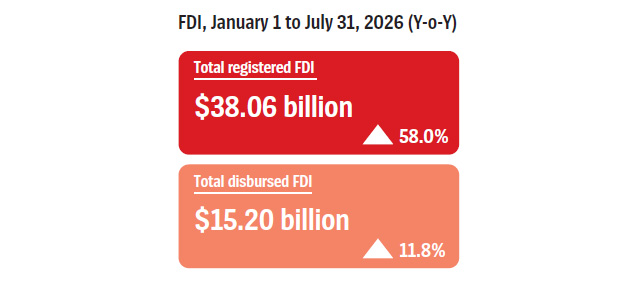
Beneath these encouraging figures, however, a structural shift in FDI deserves close attention. During the first seven months of the year, foreign investors contributed $6.58 billion through capital contributions and share purchases. Of that amount, $4.23 billion came from share acquisitions that did not increase companies’ charter capital. Compared with the same period last year, not only did the total value of these transactions rise sharply, but the average deal size also increased, from $2.225 million in 2025 to $3.419 million in 2026.
This trend suggests that FDI is expanding not only by financing new investment but also by increasing foreign ownership of existing domestic businesses. Such transactions are a normal feature of a market economy and can deliver important benefits through improved management, technology transfer, and market access. However, if this trend becomes widespread while domestic firms remain relatively weak, it could gradually reduce domestic ownership of parts of the country’s productive capacity; an issue policymakers should monitor closely.
Vietnam’s FDI strategy must therefore shift from attracting more capital to attracting better-quality investment. Success should be measured not by the number of projects or the size of registered capital alone, but by technology spillovers, stronger domestic enterprises, higher localization rates, and deeper links between FIEs and domestic enterprises. Only then can FDI become a genuine driver of stronger domestic capabilities.
Attracting more investment is an important first step. Transforming that capital into greater competitiveness for Vietnamese businesses is the true measure of long-term success.
New growth constraints
Vietnam’s economic performance during the first seven months of 2026 presents a notable paradox. Many headline indicators continue to improve, yet constraints on the quality and sustainability of growth are also becoming more apparent. These are not immediate risks, but if left unaddressed, they could become obstacles to sustaining rapid, long-term growth.
First, growth continues to rely heavily on the FDI sector, while the economy’s domestic capabilities are improving only gradually. FIEs continue to dominate exports, investment, and participation in global value chains, while domestic businesses still struggle to expand markets, improve productivity, and integrate more deeply into international production networks. If this gap persists, Vietnam’s economic autonomy will remain vulnerable to external shocks.
Second, trade and investment are expanding faster than the quality of growth. Merchandise trade continues to hit record levels, but the widening trade deficit, limited domestic value-added, and weakening terms of trade suggest that stronger trade does not necessarily translate into higher national income. Likewise, while investment has increased sharply, improving its efficiency, spillover effects, and the economy’s capacity to absorb capital has become increasingly important.
Third, business resilience remains fragile. The rising number of new businesses is encouraging, but business closures remain elevated, particularly in the services sector. This suggests that while confidence has improved, many firms have yet to fully recover their financial strength, competitiveness, and ability to withstand market volatility.
Fourth, domestic demand is recovering, but not strongly enough to become the economy’s primary growth engine. Consumption has improved and benefited significantly from the surge in international tourism, yet household spending remains subdued.
Fifth, inflationary pressures are gradually building, even if they have yet to become fully visible. Consumer prices remain within the government’s target range, but rising input costs, expanding credit, higher public investment, and continued volatility in global energy markets suggest that macro-economic policy will face tighter constraints over the remainder of the year. This underscores the need for close coordination between fiscal, monetary, and price management policies to contain inflation while sustaining growth.
Taken together, these constraints are not the result of a single economic shock. Rather, they reflect Vietnam’s transition into a new stage of development. Having moved beyond the initial recovery phase, the challenge is no longer simply to grow faster, but to grow through higher productivity, greater innovation, and stronger domestic capabilities. Strengthening these foundations will also improve the economy’s resilience in an increasingly-competitive global environment. The most important question is no longer how fast the economy is growing today, but whether the drivers of future growth are becoming stronger.
Building growth capacity
The encouraging news from the first seven months of 2026 is that Vietnam has largely moved beyond short-term recovery and entered a phase of building new growth drivers. That transition, however, also requires a shift in policy priorities.
Where policymakers once focused primarily on restoring growth, the emphasis must now shift toward improving its quality. Every policy decision should therefore aim to strengthen domestic capabilities, improve the efficiency of investment, foster competitive domestic enterprises capable of integrating into global value chains, and gradually reduce dependence on external growth drivers. The current recovery will have lasting value only if it is transformed into new sources of long-term growth.
Vietnam’s performance during the first seven months of 2026 demonstrates that the government has managed macro-economic policy with flexibility and responsiveness, preserving stability despite a challenging global environment. Yet the emergence of new growth constraints means that policy during the remainder of the year must focus not only on sustaining growth, but also on improving the quality of its underlying drivers.
First, maintaining macro-economic stability should remain the top priority. Though inflation remains under control, price pressures have not disappeared.
Second, public investment should continue to accelerate, but with greater emphasis on quality rather than disbursement alone.
Third, policymakers should pursue more meaningful progress in developing the domestic business sector. The objective should not simply be to increase the number of new businesses, but to improve their survival rates, productivity, and ability to scale.
Fourth, FDI policy should place greater emphasis on quality than quantity. Vietnam should remain an attractive destination for international investment while strengthening links between FIEs and domestic enterprises, increasing localization, encouraging technology transfer, and developing support industries.
Fifth, stronger efforts are needed to unlock domestic consumption. Alongside inflation control, policies should continue to support employment, raise real household incomes, develop the domestic market, and maximize the spillover benefits of tourism, commerce, and the digital economy.
Sixth, Vietnam should focus on improving the quality of international trade. Export policy should gradually shift from maximizing export volumes to increasing domestic value-added, strengthening national brands, raising localization rates, and expanding into higher-value export markets.
Macro-economic management in the years ahead should therefore aim not only to maximize growth in 2026, but also to build the foundations for stronger, more sustainable, and more self-reliant growth over the longer term. That is the true measure of successful economic management and the path toward realizing Vietnam’s long-term development ambitions.
The first seven months of 2026 suggest that Vietnam’s greatest challenge is no longer finding new sources of growth, but improving the quality of the sources it already has. Today’s strategies and policy decisions should therefore focus on building an economy with stronger domestic capabilities, greater resilience, and a more sustainable growth model in an increasingly uncertain world.
(*) Dr. Nguyen Bich Lam is the former Director General of the General Statistics Office (now the National Statistics Office at the Ministry of Finance)


 Google translate