


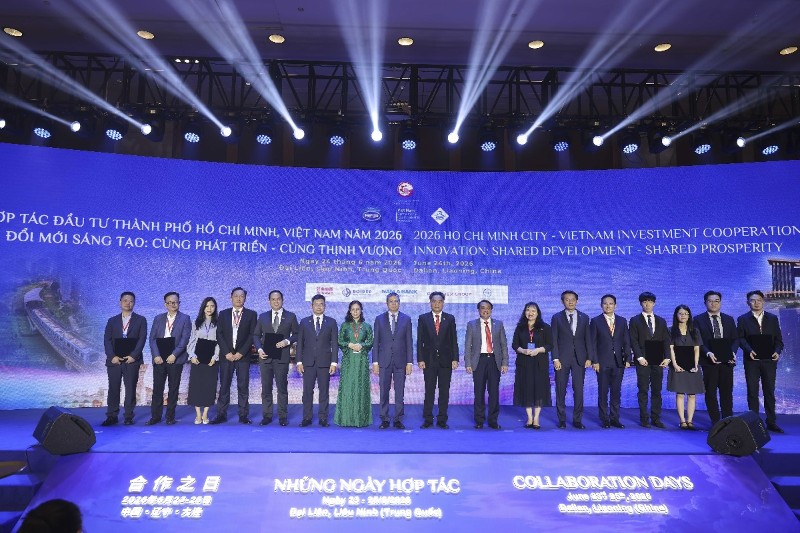
Ho Chi Minh City is not merely focused on attracting new investment projects; more importantly, it stands ready to "co-create" new growth drivers and spaces for cooperation with international partners, stated Mr. Nguyen Loc Ha, Permanent Vice Chairman of the City People's Committee.
Mr. Ha led a city delegation to the 17th Annual Meeting of the New Champions of the World Economic Forum (WEF AMNC 2026), held in Dalian, China, from June 22 to 26, according to the Center for the Fourth Industrial Revolution in Ho Chi Minh City (HCMC C4IR),
In his speech, Mr. Ha emphasized the city's ambition to gradually establish a strategic dialogue and linkage axis connecting the World Economic Forum in Davos (Switzerland), the Annual Meeting of the New Champions (AMNC) in China, and the annual Ho Chi Minh City Autumn Economic Forum.
This strategic direction aims to elevate the roles of major metropolitan areas and the business community, transforming them into new growth poles with a standing commensurate with their position in the global economic structure.
In addition to the official forum activities, the delegation carried out several investment promotion and partnership networking programs. Notably, the "Collaboration Days" event series, chaired by Ho Chi Minh City, attracted nearly 1,000 delegates, businesses, and organizations, while witnessing the announcement of nine cooperation agreements across various sectors.
According to HCMC C4IR, these collaborative activities continue to affirm the city’s development orientation toward deep science, technology, innovation, and digital transformation. At WEF AMNC 2026, HCM City expanded its cooperation with major corporations such as Sunwah, Exabyte, Inspur Smart Technology and TOJOY to deploy models for smart cities, green materials, robotics, and automation.
Beyond industry and technology, side events at WEF AMNC 2026 also focused on high-tech agricultural development and strengthening cross-border value chain linkages.
HCMC C4IR reported that several Agricultural Technology (Agritech) models were introduced for potential application in the city. These include Israel’s National Climate Technology Program, Fermata’s computer vision solutions for crop monitoring, South Korea’s AI-driven food logistics management system, and the Liao Yu Group’s ocean circular economy model.
These solutions will be surveyed and evaluated to serve the city’s "Large-scale High-tech Urban Agriculture" project.
 Google translate