


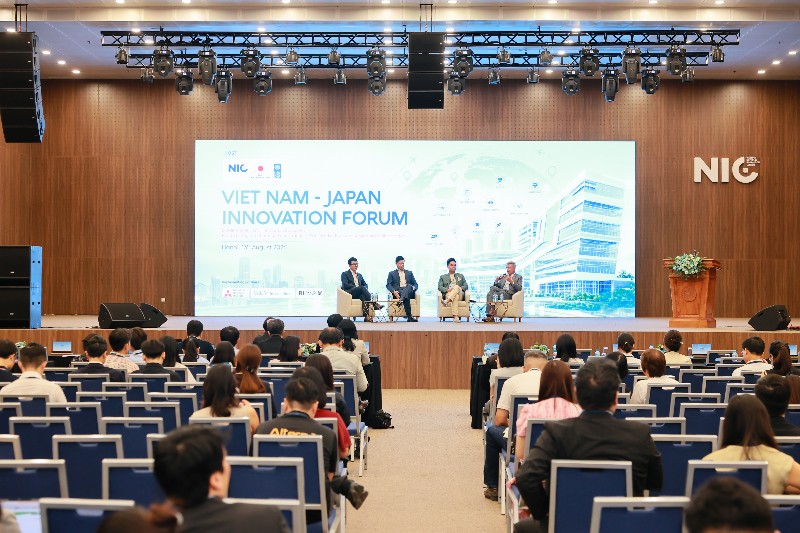
The Vietnam-Japan Innovation Forum 2026 took place on August 13 at the Vietnam National Innovation Center (NIC) in Hanoi-based Hoa Lac High-Tech Park (HHTP), aiming to creat connection among authorities, technology enterprises, startups, investors, universities, research institutes, and international organizations from both Vietnam and Japan.
It also sought to promote technology co-creation, facilitate investment and business linkages, and initiate concrete collaborative projects in strategic technology sectors.
The Forum was part of the Project for "Vitalizing the Vietnam National Innovation Center," funded by the Government of Japan and implemented by the United Nations Development Programme (UNDP) in collaboration with the NIC.
Bright spots
A key highlight of the forum was the announcement of the establishment of the Vietnam-Japan Semiconductor Human Resource Development Working Group, aimed at strengthening coordination among regulatory bodies, enterprises, and educational and research institutions from both nations to develop the workforce for the semiconductor industry.
The semiconductor industry is a strategic technology sector and a priority in the cooperative framework for science, technology, and innovation between Vietnam and Japan. The working group comprises the Embassy of Japan in Vietnam, Japan’s Ministry of Economy, Trade and Industry (METI), Japanese semiconductor companies, the NIC and four key technical universities in Vietnam, including Hanoi University of Science and Technology; University of Engineering and Technology under the Vietnam National University, Hanoi; Ho Chi Minh City University of Technology under the Vietnam National University, Ho Chi Minh City; and Da Nang University of Science and Technology under the University of Da Nang.
The working group will focus on identifying the supply-demand gap for semiconductor talent and aligning the practical needs of enterprises with the training and research capabilities of universities. This effort aims to foster collaborative programs for training, development, and talent connectivity in the semiconductor sector between Vietnam and Japan. This initiative is expected to serve as a foundation for the two sides to further expand cooperation in developing a high-quality workforce and deepening their participation in the semiconductor value chain.
The Forum also featured activities marking the first anniversary of the NIC’s Strategic Technology Networks, highlighting the journey from their inception to the initial results achieved in resource connection, workforce development, and the promotion of technological collaboration.
In the cybersecurity sector, the network has implemented training programs and cultivated a team of cybersecurity engineers, thereby helping to supply high-quality human resources to a field that plays an increasingly vital role in digital transformation and the development of the digital economy.
In the realm of quantum technology, the network successfully organized the International Quantum Computing Hackathon for Social Good (QC4SG 2026). This event created a platform for experts, researchers, businesses, and the younger generation to explore, experiment with, and develop ideas for quantum technology applications, while simultaneously expanding Vietnam's connections with the global quantum technology community.
Building upon specific cooperation programs, the NIC is also gradually establishing the Vietnam–Japan Innovation Hub at HHTP, as part of a project funded by the Japanese government and implemented by the UNDP in collaboration with the NIC. This hub is envisioned as a platform for substantive technology cooperation, where enterprises, research institutes, and universities from both nations can engage in joint research, testing, training, and investment networking.
Building Innovation Ecosystems
Speaking at the Forum, Mr. Hoang Trung Hieu, Deputy Director of the NIC, affirmed that with its assigned mission, NIC is committed to continuing its partnership with Japanese stakeholders—ranging from government agencies, organizations, research institutes, and universities to the business community and investors—to pool resources, foster collaboration, and create new value.
"NIC also looks forward to the continued interest, support, and partnership of the Japanese Government and the Embassy of Japan in Vietnam," he added. "We aim to implement an increasing number of practical and meaningful cooperative programs and projects at NIC, thereby translating cooperation commitments into concrete, long-lasting, and far-reaching results.”
Ms. Ramla Khalidi, UNDP Resident Representative in Vietnam, highly valued the Comprehensive Strategic Partnership between Vietnam and Japan, as well as Vietnam’s strategic focus on placing science, technology, innovation, and digital transformation at the core of the country's next phase of development.
“For Vietnam to sustain rapid growth and enhance competitiveness in an increasingly technology-driven global economy, knowledge and innovation must become stronger drivers of productivity and value creation," she emphasized. "This requires investment, skills, robust institutions, and, above all, partnerships. An innovation center is only truly strong when ideas are developed and partnerships are forged within it, and when entrepreneurs and researchers effectively utilize and leverage the resources available there.”
Ms. Khalid encouraged startups, researchers, investors, universities, and businesses from both nations to fully capitalize on this opportunity—bringing forward new ideas, conducting trials and validation, seeking partnerships, and transforming high-potential technologies into solutions that generate economic, social, and environmental value.
From the Japanese perspective, Mr. Ishikawa Isamu, Deputy Ambassador of Japan to Vietnam, highlighted the long-standing cooperative foundation between the two countries regarding the development of the HHTP, from Japan International Cooperation Agency (JICA)’s formulation of the HHTP master plan nearly three decades ago to the current advancements in the innovation ecosystem.
The Deputy Ambassador also affirmed that the Japanese Government would continue to implement specific cooperation programs to support Vietnam’s innovation development, including the Project for "Vitalizing the Vietnam National Innovation Center".
People-centric collaboration
To promote Vietnam - Japan cooperation, Ms. Khalid believes that innovation is driven not only by infrastructure, but also, and more importantly, by people. A hub is only as valuable as the ideas developed within it, the partnerships formed around it, and the entrepreneurs and researchers who actually use it.
"I encourage startups, scientists, investors, universities, and enterprises from both countries to make full use of this opportunity," she added. "Bring your ideas, test them, challenge them, find partners, and turn promising technologies into solutions that create economic, social, and environmental value. Every partnership formed here, every technology tested here, and every idea exchanged here will help strengthen Vietnam’s innovation ecosystem and deepen the innovation partnership between Vietnam and Japan."
Vietnamese Former Deputy Prime Minister Nguyen Chi Dung affirmed that Japan has consistently been one of Vietnam's top partners, boasting strong foundations in science and technology, industry, the business sector, research institutes, and leading universities.
Meanwhile, Vietnam possesses a dynamic economy, a young workforce, strong technological adaptability, and a determination to develop strategic technology sectors. The two nations enjoy numerous complementary advantages that can drive mutual development. The challenge lies in how to harness these advantages to create a combined strength for shared growth.
"To address challenges and create new value, the spirit of Vietnam-Japan cooperation in this new era must be people-centered, driven by technology and innovation, and grounded in enterprises and practical challenges, while resting on a foundation of mutual development and mutual benefit," Mr. Dung noted.



 Google translate