


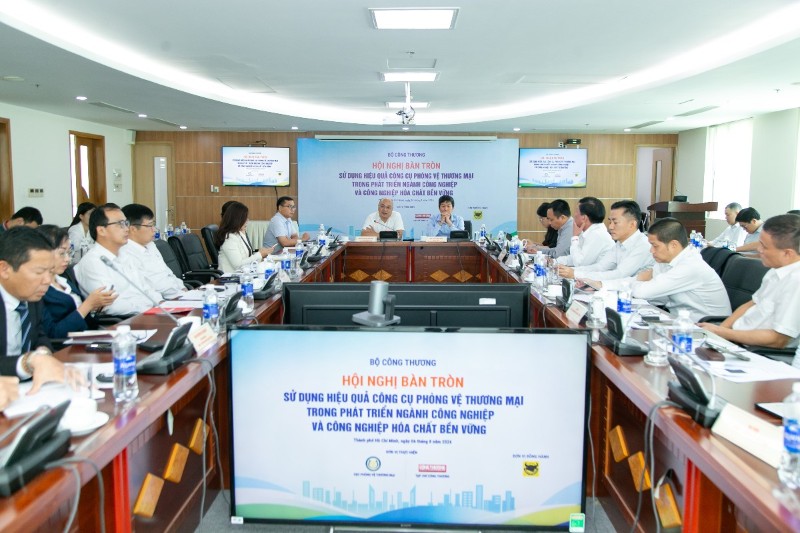
To promote sustainable industrial development, a synchronized coordination of various policies is required, ranging from credit and investment to sectoral development strategies. Among these, trade defense instruments play a crucial role in ensuring a fair and healthy competitive environment between domestic and imported goods.
This was emphasized by Mr. Chu Thang Trung, Deputy Director of the Trade Remedies Authority of Vietnam under the Ministry of Industry and Trade (MoIT), during a roundtable discussion titled "Effective Use of Trade Defense Instruments in Developing Industry and a Sustainable Chemical Industry" held on August 6.
Amidst the global trend of increasing trade defense measures, Vietnamese enterprises are not only facing investigations in foreign markets but also need to proactively and effectively use these legal tools to protect domestic production. Practice shows that trade defense measures are currently applied extensively in foundational industries such as steel, chemicals, and plastics, affirming their core role in protecting manufacturing sectors against unfair competition.
Highlighting the specific role of the sector, Mr. Pham Huy Nam Son, Deputy Director General of the Vietnam Chemicals Agency (MoIT), noted that the chemical industry is a foundational sector providing essential inputs for various fields, including agriculture, healthcare, electronics, mechanics, construction materials, and many other processing and manufacturing industries. Therefore, developing the chemical industry toward modernity, autonomy, and sustainability is of great significance to the nation's industrialization and modernization process.
In the context of increasingly fierce international competition and fluctuating global raw material markets, Mr. Son said, developing domestic production capacity must be implemented in tandem with policies on investment, trade, and trade defense.
The effective use of trade defense instruments not only protects foundational industries from unfair competition by imported goods but also creates space for enterprises to invest in technological innovation, improve product quality, and gradually build a more competitive chemical supply chain, he said.
Providing a specific analysis of the petrochemical industry, Mr. Wichai Techachindawong, Deputy General Director of Long Son Petrochemicals Co., Ltd. (LSP), stated that global oversupply and pressure from low-priced imports are placing significant strain on domestic projects. In this context, trade defense should be viewed as an integral component of the industrial development policy ecosystem, ensuring a level playing field so that enterprises can confidently expand their investments.
Assessing the current landscape, Mr. Trung noted that many domestic industries have recently been proactive in researching and engaging with the Trade Remedies Authority to explore the use of trade defense instruments to protect their legitimate interests. Some sectors have already begun compiling evidence and preparing dossiers to request the initiation of investigations.
Nevertheless, Mr. Trung candidly pointed out that many enterprises continue to struggle with preparing dossiers, providing the required information, and meeting the complex legal standards mandated by law.
Echoing this sentiment, Mr. Son observed that while many businesses have boldly invested in the chemical and petrochemical sectors to gradually establish domestic production capacity, many basic chemical products remain dependent on imported raw materials. This dependency, combined with intensifying competition from imports, necessitates synchronized solutions to develop local value chains.
Drawing from management experience, Mr. Son proposed strengthening linkages between raw material producers and downstream users to create integrated supply chains. He also emphasized the need to optimize early warning systems and enhance information sharing between regulatory agencies, industry associations, and businesses to promptly identify market fluctuations and apply appropriate response measures.
Mr. Vu Xuan Hung, representing the Ho Chi Minh City Branch of the Vietnam Chamber of Commerce and Industry (VCCI), highlighted that Vietnamese enterprises currently face dual pressures: responding to trade investigations from abroad while proactively utilizing defense tools to protect the domestic market.
"Many enterprises still face three major limitations: passivity in accessing information, inadequate data management and traceability, and a shortage of specialized personnel. Therefore, businesses must shift their mindset from 'reaction' to 'prevention' by proactively utilizing early warning systems and standardizing their data systems," Mr. Hung said.
Head of External Relations at AGC Chemicals Vietnam Co., Ltd., Nguyen Xuan Tho, expressed his hope that regulatory authorities will continue to support businesses by providing guidance on dossier preparation, offering market insights, and maintaining regular dialogue mechanisms to resolve obstacles and reduce the burden of costs, personnel, and time for enterprises.







 Google translate