


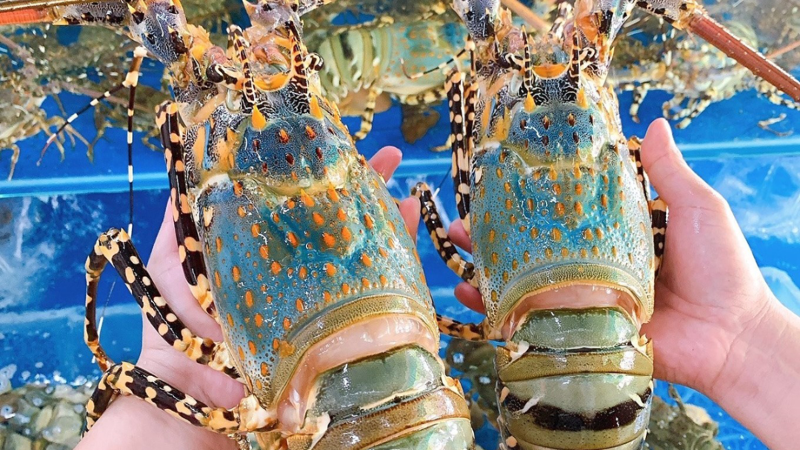
Vietnam’s lobster exports reached approximately $585 million in the first half of 2026, marking a significant 44.3% increase compared to the same period last year.
According to the Vietnam Association of Seafood Exporters and Producers (VASEP), this volume accounts for 10.1% of the country’s total seafood export turnover and nearly 25% of Vietnam’s total shrimp and lobster export value.
While shrimp has long been the leading product group in the seafood industry, the composition of exports has shifted dramatically over the past decade. From being the third-largest export item in 2020, lobster has surpassed black tiger shrimp to become the second-highest value product, trailing only white-leg shrimp.
VASEP data shows that in 2025, lobster export turnover reached approximately $858 million, with China alone accounting for $841 million—representing over 98% of the total. In the first half of 2026, this proportion rose further to roughly 98.5%. These figures highlight the clear potential for lobster to become a strategic seafood commodity.
VASEP analysts point out that Vietnam’s competitive advantage in lobster lies in its geographical proximity to China. This facilitates live transport, shorter delivery times, and competitive logistics costs. Furthermore, Vietnamese lobster is well-suited for the mid-to-high-end restaurant segment in China.
Additionally, global trade fluctuations, tariffs, and competition among suppliers such as Canada, the United States, and Australia are creating market gaps for Vietnam to solidify its position.
From a market and enterprise perspective, VASEP argues that lobster should be approached as a high-value seafood industry with its own dedicated development strategy, rather than just a short-term growth group. To realize the goal of turning lobster into a billion-dollar export industry, VASEP has proposed four key groups of solutions.
First, develop a comprehensive strategy to elevate lobster into a strategic industry aimed at a billion-dollar turnover. This includes synchronizing production zoning with infrastructure for live-seafood logistics, packaging facilities, quality standards, and traceability.
Second, prioritize technical negotiations with China to remove barriers for ornate rock lobsters. This involves clarifying requirements for F2 seeds, scientific documentation, and origin records, as well as establishing a controlled transition mechanism for commercial products from certified farming areas.
Third, provide guidance for farmers, cooperatives, and enterprises to fully comply with market requirements. This includes securing farm and packhouse codes, maintaining farming logs, and strictly controlling seeds, feed, veterinary drugs, chemical residues, quarantine, food safety, and shipment documentation.
Fourth, establish a specialized market information and early warning system for the lobster industry. This system would monitor changes in import regulations, border status, tariffs, seasonal demand, price fluctuations, and competition from Canada, the US, Australia, and other suppliers.



 Google translate