


The period from 2026 to 2030 will be a pivotal time for Vietnam to transition from a participant in the global supply chain to a developer of its own semiconductor industrial ecosystem.
This assessment was shared by experts at the "Vietnam-Singapore Semiconductor Industry Cooperation Forum 2026," co-organized by Quang Trung Software City (QTSC) and the Vietnam Trade Office in Singapore on July 21 in Ho Chi Minh City.
Currently, Vietnam has attracted numerous international semiconductor giants, including Marvell, Renesas, Infineon, Qualcomm, NVIDIA, and Hana Micron, alongside many enterprises operating in integrated circuit (IC) design, packaging, and testing. According to Research and Markets, Vietnam's semiconductor market is projected to grow by $2.22 billion between 2025 and 2030, representing a compound annual growth rate (CAGR) of approximately 7.1%.
Mr. Cao Xuan Thang, Vietnam’s Trade Counselor in Singapore, emphasized that the semiconductor industry has become a strategically vital sector for the global economy.
In this landscape, he said, Vietnam is emerging as a highly attractive destination for international investors. With a stable political environment, a young workforce, a high capacity for technology adoption, and various incentive policies for the high-tech sector, Vietnam is steadily asserting its position in the global semiconductor value chain.
Vietnam has identified the semiconductor industry as a strategic national priority and has enacted specific policies and programs to develop the ecosystem. Notable among these are the "Vietnam Semiconductor Industry Development Strategy to 2030, with a Vision to 2050" (approved under Prime Ministerial Decision No. 1018/QD-TTg) and the "Semiconductor Industry Human Resources Development Program to 2030" (approved under Prime Ministerial Decision No. 1017/QD-TTg). These are supported by investment incentives and frameworks for science, technology, innovation, and digital transformation under the Politburo's Resolution No. 57-NQ/TW and the Government’s Action Program.
“Through these initiatives, Vietnam is promoting high-quality human resource training, research and development (R&D), and supporting technology enterprises to participate more deeply in the global semiconductor value chain,” Mr. Thang said.
He noted that for many years, Singapore has been one of Vietnam's largest foreign investors, with a total investment exceeding $84 billion across more than 4,500 active projects.
Bilateral trade has also seen remarkable growth, rising from approximately SGD27 billion (approximately $16.3 billion) in 2021 to a record SGD31 billion ($24 billion) in 2024, and continuing to reach a new peak of nearly SGD40 billion (nearly $31 billion) in 2025. In the first five months of 2026, bilateral trade turnover reached SGD23.3 billion ($18 billion), an increase of more than 43% compared to the same period in 2025.
“These successes serve as a vital foundation for both countries to expand cooperation into high-tech fields, where the semiconductor industry is viewed as one of the sectors with the greatest potential over the next decade,” Mr. Thang said.
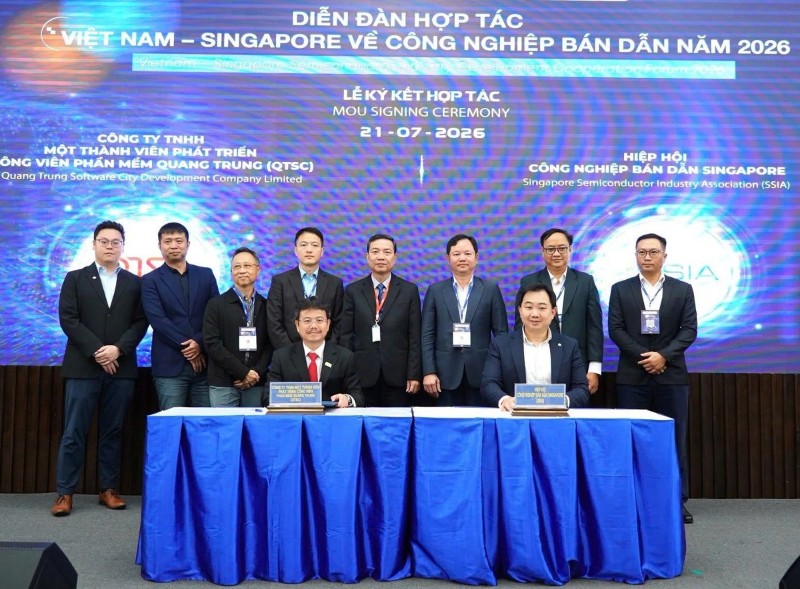
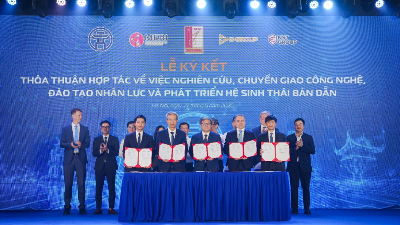
Within the framework of the forum, QTSC and the Singapore Semiconductor Industry Association (SSIA) signed a Memorandum of Understanding (MoU) aimed at fostering connectivity between the semiconductor ecosystems of Vietnam and Singapore.
Under the agreement, both parties will collaborate to promote business networking, investment attraction, research and development (R&D), technology transfer, human resource development, and the expansion of international cooperation in the semiconductor sector. Furthermore, SSIA signed additional cooperation agreements with relevant stakeholders to bolster the training of engineers and specialists, ensuring the industry’s future development needs are met.



 Google translate