


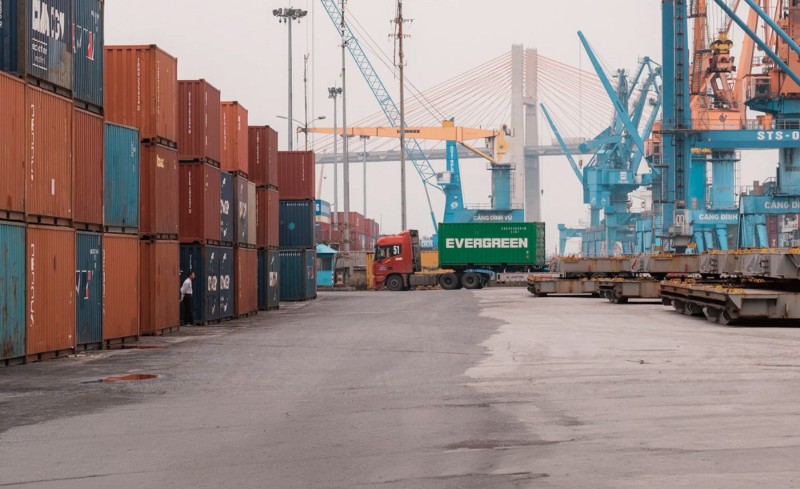
According to the latest report from the National Statistics Office at the Ministry of Finance, Vietnam’s total goods trade reached $104.22 billion in June, up 5.2 per cent from the previous month and 36.3 per cent year-on-year. In the first half of the year, total trade climbed to $549.69 billion, a 27.1 per cent increase against the same period in 2025, underscoring Vietnam’s increasingly important role in global trade.
FDI sector leads expansion
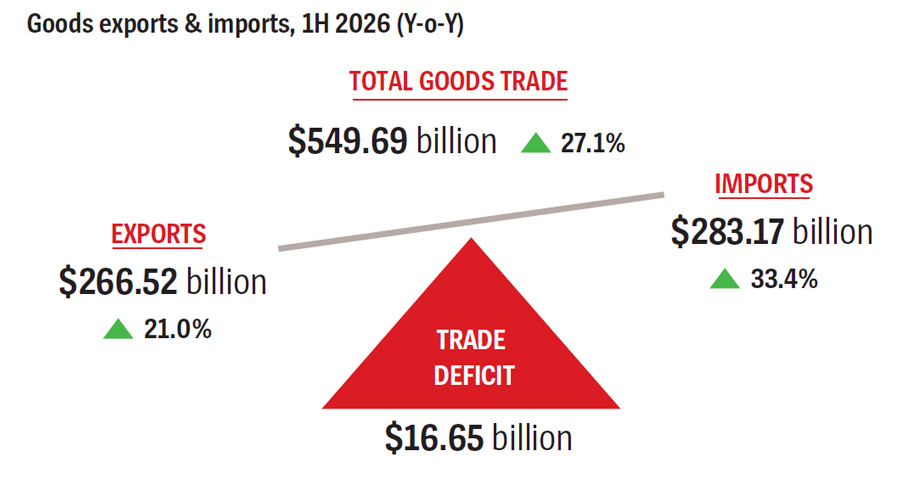
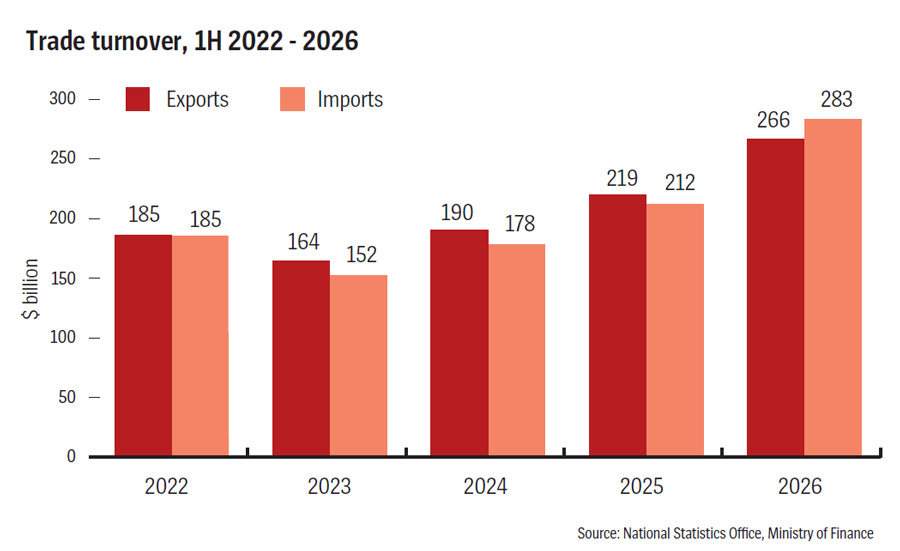
One of the report’s most notable findings is the divergence between export and import growth in the first half. While exports rose 21 per cent year-on-year to $266.52 billion, imports expanded at a faster pace, of 33.4 per cent, to $283.17 billion, resulting in a trade deficit of $16.65 billion; a sharp reversal from the nearly $8 billion trade surplus recorded a year prior. A closer look at the composition of imports, however, suggests the deficit largely reflects investment for future production rather than weakening competitiveness.
Production inputs accounted for an overwhelming 94.1 per cent of total imports, equivalent to $266.4 billion. Machinery, equipment, tools, and spare parts represented 56 per cent of total imports, while raw materials and production inputs accounted for 38.1 per cent. Such figures indicate that businesses are accelerating purchases of technology and manufacturing inputs to expand capacity ahead of stronger demand in the second half of the year.
On the export side, manufacturing continued to dominate, generating $239.8 billion and accounting for 90 per cent of total exports. Agricultural and forestry products contributed $19.23 billion, or 7.2 per cent, while fisheries exports reached $5.76 billion (2.2 per cent), and fuel and mineral products totaled $1.73 billion (0.6 per cent). Though these sectors accounted for smaller shares of total exports, they maintained steady growth, highlighting the increasing diversification of Vietnam’s export portfolio.
The emergence of 29 export products with sales exceeding $1 billion, together accounting for 92.1 per cent of total exports, including five products generating more than $10 billion and representing 62.6 per cent of export value, further demonstrates the country’s expanding large-scale manufacturing capacity.
FDI enterprises remained the principal engine of export growth. The sector generated $213.01 billion in exports during the first half of 2026, accounting for 79.9 per cent of the national total and posting year-on-year growth of 26 per cent. FDI firms also led imports, purchasing $204.71 billion worth of goods, up 37.3 per cent. The figures suggest multinational corporations continue to expand manufacturing investment in Vietnam, reinforcing the country’s position as a critical link in global value chains.
The domestic business sector, while still facing significant challenges, exported $53.51 billion worth of goods, up 4.6 per cent year-on-year. Its trade deficit of $24.95 billion also reflects increased imports of machinery and production inputs aimed at strengthening long-term competitiveness.
The US remained Vietnam’s largest export market during the first half of the year, with exports reaching $86.5 billion. China continued to be its largest source of imports, totaling $115.2 billion. Vietnam posted a trade surplus of $75.3 billion with the US, up 21.3 per cent year-on-year, and a surplus of $21.9 billion with the EU, up 15.2 per cent. Its surplus with Japan stood at $1.2 billion, down 5 per cent. Meanwhile, its trade deficit with China widened to $77.3 billion, up 39 per cent, while deficits with South Korea and ASEAN increased to $26.4 billion and $10.1 billion, respectively, rising 81 per cent and 36.1 per cent.
Coordinated policies
Despite encouraging trade growth, policymakers acknowledge that maintaining external balances while sustaining rapid export expansion will require coordinated policy support.
Speaking at a recent conference on recording double-digit export growth, organized by the Ministry of Industry and Trade (MoIT), Deputy Minister Phan Thi Thang emphasized that exports remain one of Vietnam’s primary engines of economic growth, supporting industrial production, employment, macro-economic stability, and the country’s standing in global supply chains. However, as international markets impose increasingly stringent environmental, sustainability, and technical standards, Vietnam can no longer rely solely on its traditional competitive advantages. Achieving the Party and government’s ambitious double-digit growth target for the year as a whole, she said, will require a fundamental shift in both public administration and business adaptability.
The MoIT has sought to improve the business environment through regulatory reform, eliminating 367 of 658 business conditions, or more than 55.7 per cent, abolishing 111 administrative procedures, and simplifying another 177. Beyond reducing compliance costs for businesses, the reforms signal the government’s commitment to creating a more supportive environment for manufacturing and exports.
Going forward, the Ministry will continue working with the Ministry of Finance (MoF) and the Ministry of Agriculture and Environment (MAE) to comprehensively review regulations and remove bottlenecks affecting logistics and port infrastructure.
At the same time, it is stepping up efforts to maximize the benefits of Vietnam’s free trade agreements (FTAs), accelerate digital transformation in trade management and market intelligence, and strengthen trade remedy early-warning systems for exporters. Longer-term priorities include resolving market access challenges, developing support industries, increasing localization rates, and enhancing the resilience of domestic supply chains to improve the competitiveness of Vietnamese exports.
Addressing the conference, Permanent Deputy Prime Minister Pham Gia Tuc called on ministries, local authorities, and the business community to implement coordinated measures to accelerate exports and support Vietnam’s longer-term goal of achieving double-digit economic growth.
He said the MoIT should strengthen its coordinating role by helping businesses capitalize more effectively on existing FTAs while pursuing negotiations on new-generation agreements. The Ministry should also enhance its monitoring of trade barriers and modernize trade promotions by integrating activities more closely with investment and tourism promotion to strengthen Vietnam’s international brand.
The MoF was tasked with further improving tax and customs policies, expanding digitalization, streamlining administrative procedures, facilitating exports, and strengthening controls against origin fraud and illegal transshipment to protect the reputation of Vietnamese products. The MAE was urged to develop raw material regions, improve agricultural quality, and promote deeper processing to increase export value. The State Bank of Vietnam was directed to maintain flexible monetary policy and improve businesses’ access to credit, while the Ministry of Construction was assigned to further study the development of seaport infrastructure, logistics networks, and cold-chain facilities.
Local authorities were urged to take a more proactive role in addressing business concerns, while industry associations were encouraged to promptly report emerging challenges. Businesses, meanwhile, were advised to strengthen production and business strategies, enhance competitiveness, capitalize on opportunities created by international integration, expand into new markets, and increase exports.
According to economists, Vietnam’s ambition of achieving double-digit economic growth remains challenging but attainable, particularly as global supply chains continue to undergo structural realignment. The surge in imports of machinery, equipment, and production inputs during the first half of 2026 is widely viewed as laying the foundation for a new wave of high-value export growth in the time to come.


 Google translate