


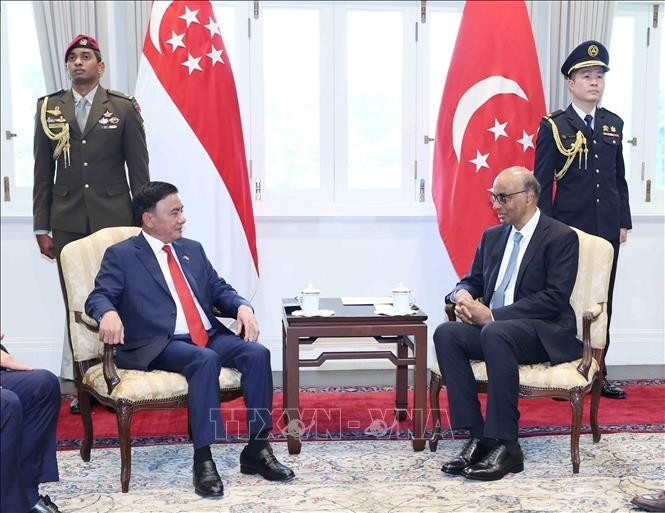
During his official visit to Singapore, Politburo Member and Permanent Member of the Communist Party of Vietnam (CPV) Central Committee’s Secretariat Tran Cam Tu met with Singaporean leaders on the afternoon of August 25.
Both sides agreed to deepen the Comprehensive Strategic Partnership, aiming for breakthroughs in AI, semiconductors, the digital economy, green finance, and high-quality human resource training.
At the meeting with President Tharman Shanmugaratnam, both leaders noted that economic, trade, and investment cooperation continue to be a bright spot. Investment has focused on manufacturing, logistics, finance, and high technology. They also agreed to continue upgrading cooperation models to be greener, smarter, and more sustainable.
Mr. Tu emphasized that the current priority is to deepen the Comprehensive Strategic Partnership framework, translating high levels of political trust and agreements between the two countries' leaders into specific programs, projects, and tangible cooperation results.
Accordingly, the two countries need to better leverage the complementary nature of their economies while improving the quality and sustainability of trade and investment cooperation. Simultaneously, they aim to create breakthroughs in emerging fields such as artificial intelligence, digital transformation, the digital economy, semiconductor technology, data centers, the green economy, clean energy, green finance, and high-quality human resource training.
Cooperation in this new phase should gradually shift toward sectors with higher technology, knowledge, and value-added content—not only leveraging existing advantages but also co-creating new growth drivers.
President Shanmugaratnam highly valued Vietnam’s socio-economic achievements and its rising international stature. He remarked that both countries possess favorable conditions to promote their complementary strengths, particularly in the new economy, technology, innovation, and human resource development.
The two sides agreed to strengthen science and technology connectivity and promote the triple helix cooperation model between the two nations (involving the state, scientists, and businesses). This will facilitate joint research, development, production, and the attraction of investment into next-generation high-tech industries.
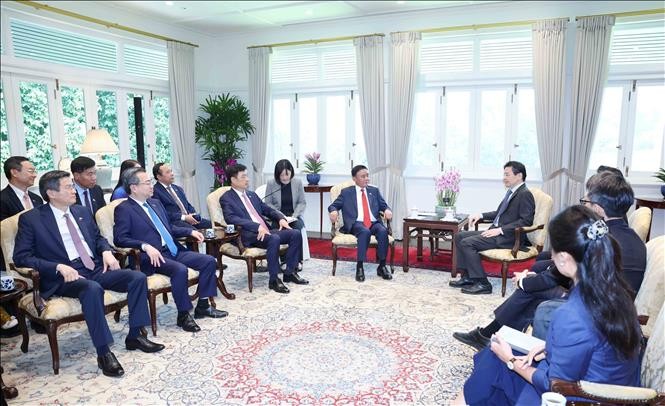
During the meeting with Prime Minister Lawrence Wong, the two leaders agreed that science, technology, and innovation should become a key pillar of the Vietnam-Singapore relationship. They pledged to strengthen connectivity in emerging technologies, AI, digital transformation, the digital economy, semiconductors, clean energy, and green finance.
In this spirit, Mr. Tu proposed promoting a cross-border innovation model known as the "Triple Helix” which strengthens the link between the State, academia (universities/research institutes), and the business sectors of both Vietnam and Singapore.
Under this model, stakeholders from both nations could engage in co-research, co-development, and co-production to "co-create value." This would initially serve the development needs of each country and eventually provide competitive products and solutions for the ASEAN and regional markets.
PM Wong affirmed that Singapore highly values Vietnam’s role, potential, and development prospects. He noted that there is significant room to shift cooperation from traditional sectors to industries with higher technological, knowledge, and value-added content.
Both sides agreed that for these cooperative orientations to take effect soon, there must be the synchronized participation of ministries, sectors, localities, businesses, universities, research institutes, and innovation centers.
In his meeting with Senior Minister K. Shanmugam, Mr. Tu requested that Singapore continue to share its experience in macro-management, scientific development, new economic sectors, and high-quality human resource training, thereby helping to create "shared development spaces" between the two countries.
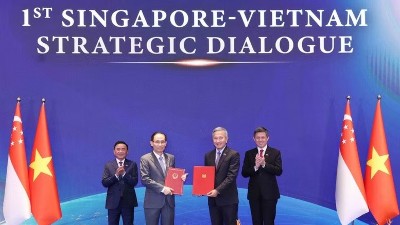
Mr. Shanmugam affirmed that Singapore would continue to coordinate closely with Vietnam to effectively leverage the Vietnam-Singapore Strategic Dialogue mechanism. He also pledged to promote cooperation between the Singaporean Ministry of Home Affairs and its Vietnamese counterpart, particularly in combating transnational crime.
During these meetings, both sides also agreed to continue coordinating closely within ASEAN and other multilateral frameworks to consolidate solidarity and unity, while enhancing the resilience and centrality of ASEAN in the regional architecture.


 Google translate