


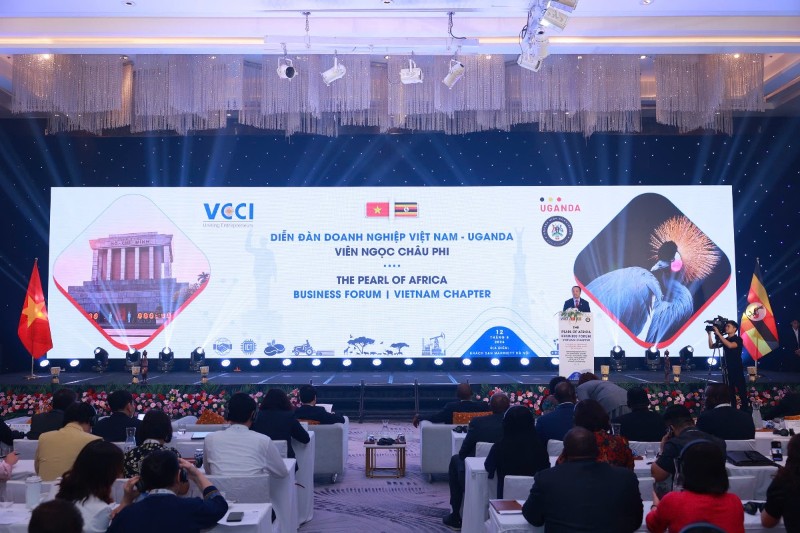
Africa is becoming a global investment hub thanks to its young workforce, rapid urbanization, and the implementation of the African Continental Free Trade Area (AfCFTA).
Within this broader context, Uganda has emerged as a key economy in East Africa, owing to its strategic location connecting the East African Community (EAC). Its rich mineral resources, fertile land, high economic growth rate, and abundant labor force make Uganda a promising destination for international investors, including those from Vietnam.
The assessment was made by Deputy Minister of Foreign Affairs Le Anh Tuan during the "Vietnam-Uganda Business Forum: The Pearl of Africa," held in Hanoi on August 12.
In recent years, the traditional friendship between Vietnam and Uganda has seen positive progress. Bilateral trade turnover in 2025 reached $53.4 million, nearly double the $28.6 million recorded in 2024. To date, Vietnam has three investment projects in Uganda with a total registered capital of approximately $35 million.
Despite these positive signals, both sides acknowledge that current trade and investment activities remain relatively modest.
“In reality, economic cooperation between Vietnam and Uganda is still limited and does not yet match the potential and needs of both sides,” said Mr. Tuan.
Explaining why trade and investment have not reached their full potential, Vice President of the Vietnam Chamber of Commerce and Industry (VCCI) Nguyen Quang Vinh cited limited market information and geographical distance as factors that prevent many Vietnamese enterprises from fully seizing opportunities in Uganda. Furthermore, high logistics costs and differences in legal environments, business practices, and corporate cultures remain significant bottlenecks hindering investment flows.
Towards sustainable and mutually beneficial partnership
To turn potential into substantive cooperation, Deputy Foreign Minister Tuan suggested that the two countries increase the exchange of delegations at all levels and establish regular connection mechanisms between ministries, sectors, and business communities to identify opportunities and resolve obstacles in economic cooperation.
Both sides need to assist businesses in identifying priority product lists and investment policy information, while pushing for the signing of key framework agreements, such as the Double Taxation Avoidance Agreement and the Investment Promotion and Protection Agreement, according to the Deputy Foreign Minister.
Additionally, there is room for further research and cooperation in emerging sectors such as digital transformation, oil and gas engineering, infrastructure construction, and resource extraction.
Mr. Vinh emphasized that VCCI would step up the sharing of information regarding Uganda’s strengths, such as agricultural products, coffee, minerals, and tourism. The body will also organize training programs to equip Vietnamese enterprises with the necessary knowledge of local business culture.
Ugandan Ambassador to Vietnam, H.E. Ms. Betty O. Bigombe, expressed her hope that Vietnamese investors would increase their presence in Uganda to add value to local products, thereby turning Uganda into a gateway for Vietnamese businesses to reach the wider African market.
Uganda stands ready to cooperate deeply with Vietnam in technology transfer, human resource training, and strengthening the links between the governments and business communities of both nations, the ambassador said.


 Google translate