



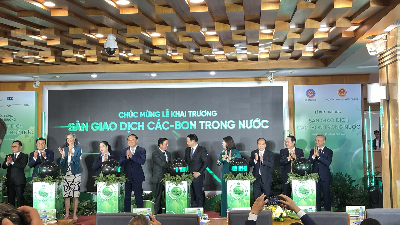
On June 29, the Ministry of Finance (MoF), in coordination with the Ministry of Agriculture and Environment (MAE), officially launched Vietnam’s domestic carbon exchange. Speaking at the inauguration, Mr. Nguyen Anh Phong, Chairman of the Hanoi Stock Exchange (HNX), said the launch represents more than a technical milestone, as it links environmental responsibility with corporate economic interests while supporting the country’s long-term sustainable development.
Completing infrastructure
Known internationally as an Emissions Trading System (ETS), the carbon exchange is a mandatory market where greenhouse gas emission allowances and carbon offset credits are traded within a country.
According to the latest World Bank data, there are now 40 ETS markets worldwide, including Vietnam. As of April 1, the EU had the world’s highest carbon allowance price, at $85 per metric ton of carbon dioxide equivalent (tCO2e), followed by the UK at $55, New Zealand at $24, and China at $12.


The carbon market not only supports businesses in achieving Vietnam’s net-zero emissions by 2050 target, but also provides a mechanism for companies to optimize emission reduction costs through the trading of emission allowances and carbon credits. In doing so, it advances the government’s sustainable development agenda by protecting the environment without sacrificing economic growth.
Vietnam’s carbon exchange will trade two types of assets: greenhouse gas emission allowances and carbon credits. Emission allowances represent the maximum volume of greenhouse gases that regulated businesses are permitted to emit over a specified period. The government has allocated allowances for 2025-2026 to 110 facilities operating in the thermal power, steel, and cement industries. Companies exceeding their allocated limits will be required to purchase additional allowances from businesses with surplus quotas. Allowances are measured in tCO2e.
Carbon credits, meanwhile, are tradable certificates that grant the holder the right to emit one tCO2e or another greenhouse gas. Under current regulations, companies may use carbon credits to offset up to 30 per cent of their allocated emissions allowance.
For emission allowances, sellers are companies whose actual emissions fall below their allocated quotas. Carbon credits, meanwhile, are sold by developers of State-recognized carbon credit projects.
During the pilot phase, only greenhouse gas emission allowances, traded under the code VN2025, will be listed on the exchange. Ninety-two of the 110 companies that received emission quotas are participating in the initial trading phase. The pilot market will operate through 2028 before transitioning to full commercial operation in 2029. Trading service fees will be waived throughout the pilot period.
According to HNX, the exchange is part of Vietnam’s commitment made at COP26 to achieve net-zero emissions by 2050. Under Decision No. 232/QD-TTg and Decree No. 29/2026/ND-CP, HNX has worked with the Vietnam Exchange (VNX), the State Securities Commission (SSC), the Department of Climate Change at the MAE, the Vietnam Securities Depository and Clearing Corporation (VSDC), the Bank for Investment and Development of Vietnam (BIDV), and other stakeholders to establish the legal framework, operational regulations, and registration, trading, and settlement systems for the carbon market.
The information technology infrastructure connecting HNX, VSDC, the Department of Climate Change, and BIDV has been operating safely and reliably. Operational rules and procedures have also been completed. The market currently includes six qualified securities firms as founding members, alongside more than 100 regulated emitters covered by the government’s emissions allocation program. “All necessary conditions for launching Vietnam’s carbon exchange have now been fully established and are ready for operation,” Mr. Phong said.
Five priorities
While the domestic carbon exchange is now operational, authorities say the next challenge is ensuring the market develops into a stable, transparent, efficient, and sustainable platform.
Ms. Vu Thi Chan Phuong, Chairwoman of the State Securities Commission, called on VNX, HNX, and VSDC to continue working closely with the MoF and MAE to implement five key priorities.
The first is ensuring the secure, stable, and uninterrupted operation of the trading, registration, custody, and settlement systems while maintaining cybersecurity and responding promptly to operational incidents.
Second, authorities will continue refining business procedures to make participation easier for securities firms, regulated emitters, and organizations trading carbon credits, ensuring market access remains transparent and efficient.
Third, regulators will strengthen market surveillance and strictly address violations, particularly market manipulation, fraud, and other abusive trading practices, to maintain a fair and healthy marketplace.
Fourth, government agencies will expand public communication efforts by providing timely and accurate market information, improving awareness among businesses and market participants, while combating misinformation that could undermine market confidence.

Finally, authorities will continue studying international best practices, strengthening the capacity of intermediaries, securities firms, and service providers, while further refining regulations to support the market’s long-term development and international integration.
The official launch of the carbon exchange is not only a significant milestone in completing Vietnam’s green economic framework, but also demonstrates the government’s commitment to building a transparent and efficient market that helps businesses adapt to the evolving requirements of international economic integration.”
Mr. Luong Hai Sinh, Chairman of VNX’s Members’ Council, said the exchange operators are committed to fully implementing their assigned responsibilities by ensuring the secure, transparent, and uninterrupted registration, trading, custody, and settlement of emission allowances and carbon credits in full compliance with Vietnamese law.
Going forward, the operators will continue coordinating closely with government agencies to refine operational procedures, strengthen market supervision, detect and address violations promptly, and expand training and public education programs, while recommending further policy improvements based on practical experience.
New opportunities for businesses
To encourage participation during the pilot phase through the end of 2028, the government has issued Decree No. 29/2026/ND-CP, exempting participating companies from exchange service fees.
“This is a meaningful policy that demonstrates the government’s support for the business community,” Ms. Phuong said. “It encourages companies to actively implement emission reduction measures, invest in new technologies, and pursue sustainable development. The official launch of the carbon exchange is not only an important milestone in Vietnam’s green economic development but also reflects the government’s determination to build a transparent and efficient market that helps businesses adapt to new international economic integration requirements.”
Speaking on the sidelines of the launch, Dr. Nguyen Phuong Nam, Founder and CEO of climate advisory and services firm Klinova, said the exchange creates new momentum for Vietnam’s corporate green transition.
“Demand for carbon credits in Vietnam is growing rapidly, particularly among companies seeking to offset emissions that cannot be eliminated from manufacturing, business operations, or major events,” he said. “A domestic carbon exchange provides businesses with a trusted platform to purchase high-quality, transparent carbon credits to compensate for those emissions.”
However, during the pilot phase, only emission allowances, not carbon credits, will be traded on the exchange.
Dr. Nam nevertheless encouraged businesses to participate in the broader carbon credit market, noting that carbon credits serve as independent verification of a company’s environmental performance. “Green finance fundamentally depends on rigorous post-project verification,” he said. “If a project successfully generates carbon credits, it demonstrates that its environmental performance has already undergone substantial verification.”
He expressed hope that once emissions allowance trading among the initial 110 regulated companies is operating smoothly, the market will gradually expand to include businesses seeking to purchase carbon credits. “That would not only make Vietnam’s carbon market more active, accessible, and efficient, but also accelerate the green transition across the country’s economy while enhancing both corporate credibility and Vietnam’s international reputation,” he said.







 Google translate