



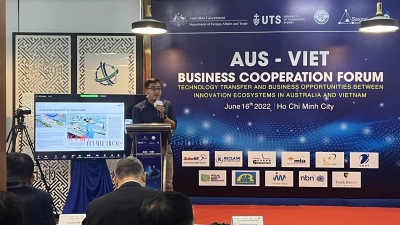
As Vietnam accelerates its green transition and pursues ambitious economic growth targets, demand for clean technologies is expanding across the energy, manufacturing, and industrial sectors. Australian businesses, researchers, and investors increasingly see opportunities to contribute technology, expertise, and capital to the endeavor, with Vietnam offering scale, manufacturing capabilities, and a rapidly-evolving policy framework. Speakers at a recent Australia-Vietnam climate technology forum discussed how the two countries can work together to move innovations from concept to commercialization and support Southeast Asia’s transition to a low-carbon economy.
From ambition to opportunity
Vietnam’s commitment to achieving net-zero emissions by 2050 is increasingly shaping the country’s economic and industrial development strategy. According to Mr. Khuat Tuan Anh, Policy Manager (Vietnam) at Climateworks Centre, Southeast Asia has become a critical region in the global energy transition, with growing manufacturing activity, urbanization, and rising energy demand expected to drive a significant share of future global energy consumption.
Within that context, Vietnam occupies a particularly important position. The country has maintained strong economic growth for decades and continues to target annual growth of 7-8 per cent, with ambitions for even higher growth in the years ahead. At the same time, electricity demand is rising even faster than economic output.
“Decarbonization is becoming part of economic strategy, not just environmental strategy,” Mr. Tuan Anh said. Vietnam’s integration into global supply chains means competitiveness is increasingly linked not only to labor costs but also to energy costs and carbon intensity. As international markets introduce stricter sustainability requirements, manufacturers are facing growing pressure to manage emissions, energy consumption, and environmental compliance.
To support this transition, Vietnam has introduced a series of policies aimed at translating long-term climate commitments into practical implementation measures. Among the most significant developments are the revised National Power Development Plan VIII (PDP8), the Direct Power Purchase Agreement (DPPA) mechanism, the development of a carbon market, and the introduction of a national green taxonomy.
Mr. Tuan Anh described PDP8 as the backbone of Vietnam’s energy policy, outlining a substantial expansion of power generation capacity and a growing role for renewable energy. By 2030, wind, solar, and hydropower are expected to account for approximately half of installed generation capacity, while coal’s role is expected to decline over time as Vietnam progresses toward its longer-term climate targets.
For investors and technology providers, these reforms provide important signals about future market direction. “The policies provide direction and incentives, but implementation requires close collaboration between stakeholders, government agencies, investors, technology providers, and industry,” he added.
Ms. Sarah Hooper, Australian Consul-General in Ho Chi Minh City, said the significance of Vietnam’s transition extends beyond its domestic market. “Australia sees Vietnam not only as a priority partner but also as a market where climate solutions can be proven, adapted, and scaled, including across Southeast Asia,” she explained.
Natural partners
Australia and Vietnam can bring their complementary strengths to climate-tech collaboration. Australia offers expertise in R&D, technological innovation, governance frameworks, and financing mechanisms. Vietnam, meanwhile, offers a rapidly-growing market, strong manufacturing capabilities, a young workforce, and an increasingly supportive policy environment.
For Mr. Oscar Omegna, Founder and CEO of The Improbability Company and VoltaRocks, those factors made Vietnam a natural choice for expansion. After spending years exploring opportunities in the country, he concluded that Vietnam offered a combination of market demand, policy ambition, and entrepreneurial energy that was difficult to find elsewhere in the region. “The people are welcoming, honest, and incredibly hardworking,” he said. “That creates a great environment in which to build businesses and develop new solutions.”
His company focuses on helping households and small businesses navigate renewable energy adoption through digital platforms that simplify decision-making around solar and battery systems. For him, Vietnam’s opportunity extends beyond emissions reduction. Reliable and affordable energy solutions can also help businesses improve operational resilience, particularly if power interruptions affect productivity.
Mr. Nguyen Bach Viet, Founder and CEO of the VioT Technology Group, shares a similar perspective. He described Australia as highly advanced in technology, the Internet of Things (IoT), and energy innovation, while Vietnam provides an environment where new technologies can be tested, adapted, and brought to market more quickly. “In Australia, bringing new technologies to market often requires considerable time due to regulatory requirements and commercialization processes,” he explained. “Vietnam, on the other hand, is a market that is eager to learn, adapt, and scale solutions quickly.”
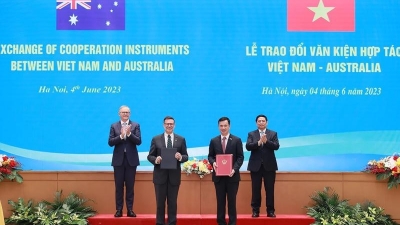
The elevation of Australia-Vietnam relations to a Comprehensive Strategic Partnership has further strengthened opportunities for collaboration. For businesses on both sides, the relationship increasingly provides a framework for technology transfer, joint innovation, and regional expansion.
From pilots to scale
Despite the opportunities, speakers at the forum agreed that commercialization remains one of the biggest challenges facing climate technology. “The real challenge is moving from good ideas to bankable projects, from pilots to scale, and from interest to long-term partnerships,” Ms. Hooper said.
Ms. Nguyen Hong Giang, Managing Director of Zenwood, identified limited access to early-stage and scale-up financing as among the most significant barriers facing climate-tech businesses in Vietnam.
While entrepreneurs are often able to develop concepts and pilot projects, obtaining the funding necessary to commercialize and expand those innovations remains difficult. Many founders rely on self-funding in the early stages, but scaling technologies requires larger pools of capital and greater investor confidence. Ms. Giang also highlighted regulatory uncertainty, technology transfer challenges, and workforce development as other key barriers.
Building the necessary skills and implementation capacity is equally important. Though Vietnam has a young and technically-capable workforce, many climate technologies require specialized expertise that must be developed through training and experience.
For Mr. Hoang Minh Tam from the Queensland University of Technology, stronger collaboration between universities and industry can help address many of these challenges. He argued that research partnerships should focus on resolving practical problems rather than remaining confined to laboratories.
Universities can provide testing facilities, technical expertise, and independent validation that help reduce technical risks and strengthen investment cases. “Research creates the greatest impact when it is connected to real industry needs and practical applications,” Mr. Tam said.
Mr. Viet also emphasized the value of industry-led collaboration. Through initiatives such as IoT Living Labs, researchers, students, startups, and corporations can work together to address real-world challenges while creating pathways for commercialization. Importantly, involving industry partners from the outset provides both market validation and potential sources of funding. “If we can strengthen collaboration between Australian universities and Vietnamese innovation ecosystems, we can create a highly-effective model,” he believes.
Building the framework
While technology and innovation are essential, climate-tech growth ultimately depends on investor confidence. That is where governance, disclosure, and financial frameworks play a critical role.
Ms. Tracey Dodd, Board Director of Green Industries SA and Senior Lecturer at Adelaide University, argued that environmental, social, and governance (ESG) frameworks are often misunderstood.


Decarbonization is becoming part of economic strategy, not just environmental strategy.”
Rather than serving simply as sustainability metrics, ESG frameworks help organizations understand and manage risk. “ESG is a framework designed to help organizations understand and manage environmental and social risks,” she said.
Investors, she continued, increasingly use ESG indicators to assess whether companies understand their exposure to environmental, social, and governance risks and whether they have systems in place to manage them effectively. Strong ESG performance can therefore help attract investment by reducing uncertainty and improving transparency. For Vietnam, ESG frameworks offer a way to signal to global markets that businesses are becoming more sophisticated in managing risks and opportunities associated with sustainability.
Australia’s recent climate-reporting reforms provide another example of how governance frameworks are evolving. Organizations are increasingly required to assess and disclose their exposure to both physical climate risks and transition risks associated with decarbonization. Those requirements are expected to create growing demand for technologies and services that help companies measure, manage, and reduce climate-related risks.
At the same time, Vietnam’s own policy reforms, including the green taxonomy, carbon market development, and renewable energy procurement mechanisms, are beginning to create a more structured environment for investment. While implementation remains a work in progress, these developments provide greater visibility and certainty for businesses considering long-term investments in the country.
In conclusion, the future of climate-tech collaboration between Australia and Vietnam will depend on more than technological innovation alone. Success will require supportive policies, access to capital, effective partnerships, workforce development, and practical pathways to commercialization. The opportunity now is to transform the complementary strengths from both countries into scalable projects, commercial partnerships, and deployable solutions that can help accelerate the region’s green transition.




 Google translate