


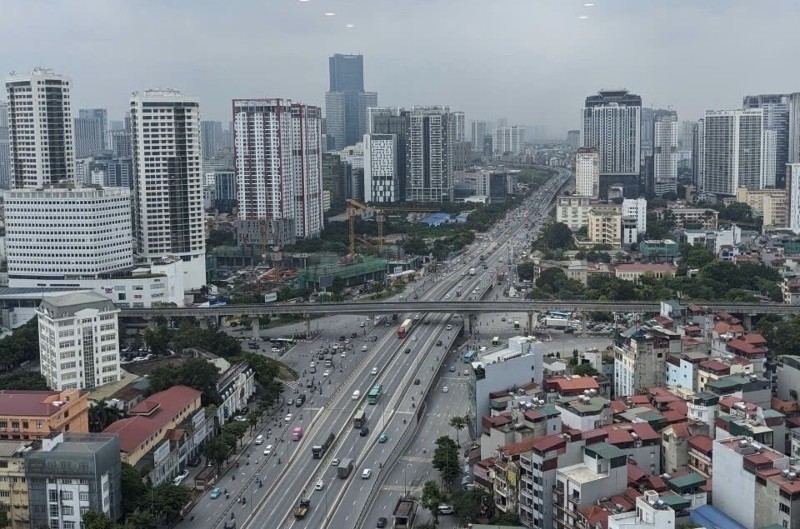
Officially signed by Chairman of the Hanoi People’s Committee Vu Dai Thang, the roadmap outlines a synchronized schedule for citywide spatial development, with immediate priority given to completing 22 key urban sub-zoning plans.
The implementation plan provides a unified basis for municipal departments, sectoral agencies, and local ward and commune People's Committees to proactively develop action plans tailored to their designated jurisdictions and administrative domains.
Under the plan, Hanoi’s spatial planning framework encompasses five major categories: urban planning, rural planning, functional area planning, technical infrastructure planning, and underground spatial planning. The practical implementation of the capital’s overarching spatial directions will adhere strictly to a defined multi-polar structural model.
Within this framework, the central pole acts as the primary urban core. The historical inner city and its expanded areas will undergo urban restructuring based on a compact-green model, underground spatial exploitation, and Transit-Oriented Development (TOD) integrated with heritage conservation.
Meanwhile, urban areas along Ring Road 4 will form a modern outer urban belt, serving as a demographic buffer to relieve population pressure on the inner core.
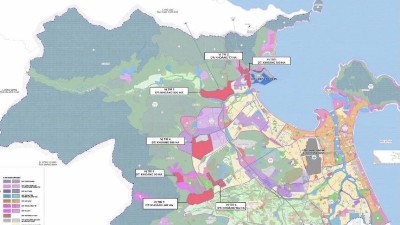
A key focal area is the Red River axis, which will be operationalized through sub-zoning plans SH-1 to SH-4 extending from upstream to downstream. This zone is designated to become a central landscape spine, an ecological park system, and an iconic cultural-service center for the capital.
The Northern pole, anchored by Noi Bai International Airport, will be integrated with a free trade zone and logistics hubs to drive dynamic regional growth.




 Google translate