



Global supply chains are undergoing profound transformations driven by geopolitical volatility, trade tensions, demands for emission reductions, and the rapid advancement of digital technology. Consequently, businesses must look beyond mere cost-efficiency to enhance resilience and supply chain transparency while meeting increasingly stringent environmental standards.
For Vietnam - an economy with a high degree of openness and deep integration into international supply chains, these shifts present both opportunities to attract relocated manufacturing and investment, and the imperative to upgrade logistics capabilities, accelerate digital transformation, and green the supply chain.
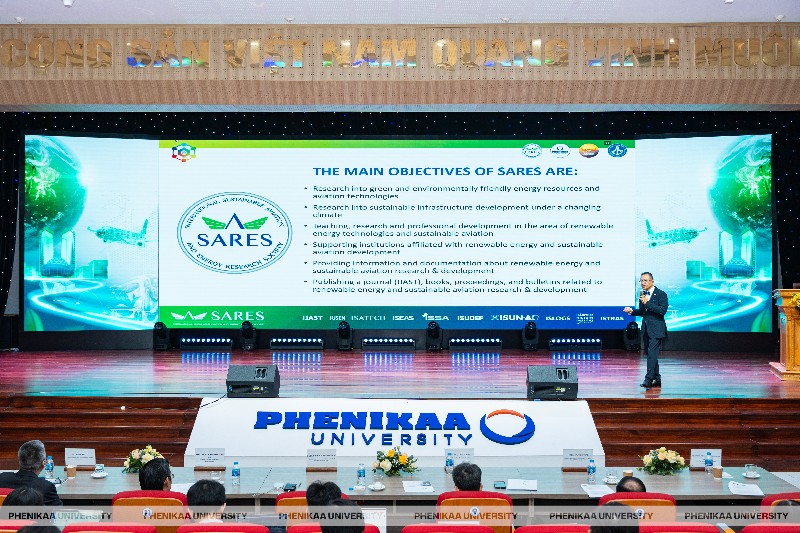
This is also a topic discussed by experts at International Symposium on Sustainable Logistics and Supply Chain (ISLOGS’26) held by Phenikaa University in collaboration with the International Sustainable Aviation and Energy Research Society (SARES), Piri Reis University (Turkey), and Great Peace International.
According to the Vietnam Logistics Business Association (VLA), Vietnam's export value reached $475.06 billion in 2025, a 17 per cent increase compared to 2024. In the first six months of 2026 alone, exports totaled approximately $266.51 billion, up 21 per cent year-on-year. "The rapid expansion in the volume of goods means that logistics networks have become more complex and time-sensitive, are more susceptible to external disruptions, and must meet increasingly stringent requirements regarding compliance and sustainable development," said Mr. Ngo Khac Le, Deputy Secretary General of the VLA.
A notable shift highlighted by experts concerns the perspective on export competitiveness. While product quality, production capacity, and cost were traditionally viewed as the primary factors, the market now also evaluates goods based on delivery times, reliability, supply chain traceability and visibility, compliance levels, resilience, and carbon footprint. Consequently, logistics is no longer merely a cost incurred at the end of the production process; it has increasingly become integral to market access and product competitiveness.
The challenge for Vietnam lies in the fact that, despite robust export growth, logistics capabilities remain uneven across the entire supply chain. From factories, industrial zones, dry ports, and domestic logistics centers to inland transport, seaports, airports, international shipping, and destination markets, a single weak link can result in lost time, reduced reliability, a lack of shipment visibility, or increased costs for businesses.
Given this reality, the challenge lies not merely in continued infrastructure investment, but in shifting the mindset from simply developing logistics infrastructure to building logistics capabilities.
Accordingly, Mr. Le pointed out five capability areas including connectivity via transport corridors and multimodal transport; efficiency regarding total logistics costs and asset productivity; reliability and resilience; data connectivity and end-to-end shipment visibility; and finally, sustainability - encompassing carbon management, compliance, and resource efficiency. The foundation enabling these capabilities comprises human resources, standards, collaboration, and policy.
For a nation with a coastline as extensive as Vietnam’s, coastal shipping is also recognized as offering significant potential for restructuring the logistics system.
Prof. Dr. T. Hikmet Karakoc of Piri Reis University, President of SARES, observes that sustainable logistics is entering a new phase where emission reduction requirements go beyond mere climate commitments to become deeply integrated into operational activities. Decisions regarding transport modes, vehicle types, fuels, and network configurations must increasingly factor in carbon efficiency alongside cost and speed.
Artificial intelligence plays a pivotal role in this transformation, facilitating everything from route optimization, improved vehicle utilization, and demand forecasting to predictive maintenance and continuous operational optimization. Alongside AI, the shift toward electrification, alternative fuels, and low-carbon energy is fostering a more diverse transport energy ecosystem; distinct sectors - ranging from road and long-haul transport to maritime and aviation, may require tailored energy solutions rather than a single, one-size-fits-all technology for the entire industry.



 Google translate