



Vietnam has significant potential to reduce greenhouse gas emissions across key sectors, including energy, industry, agriculture and forestry, and waste management. This would provide a strong foundation for tapping into green finance through the international carbon market under Article 6 of the Paris Agreement.
However, a wide gap remains between emission reduction potential and commercially-tradable carbon projects. To maximize carbon revenues, access advanced technologies, and meet global standards, businesses must first ensure strict compliance with domestic regulations and the crediting requirements established under Article 6.
The international carbon market under Article 6 has now entered a new phase compared to the era of the Clean Development Mechanism (CDM). Emission reductions must not only be examined under measurement, reporting, and verification (MRV) methods, but also be aligned with a country’s Nationally Determined Contribution (NDC), transparently tracked through registry systems, approved by the government for international transfer, and accompanied by corresponding adjustments. These new standards require a more rigorous approach to emissions accounting and additionality while preventing the double counting of emissions reductions between countries and ensuring projects support the long-term objectives of the Paris Agreement.
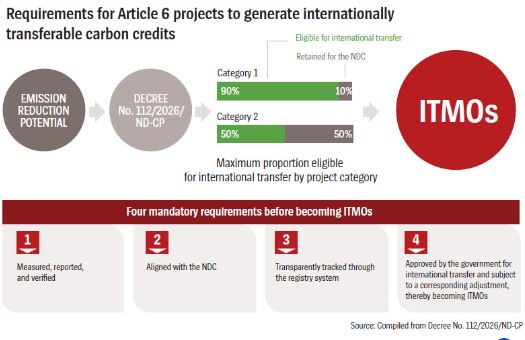
Government Decree No. 112/2026/ND-CP on the international transfer of greenhouse gas emission reductions and carbon credits has established an important legal foundation for Vietnam’s integration into international carbon markets. By clearly prioritizing the achievement of national NDC targets, safeguarding national interests, and categorizing projects into two groups subject to different transfer limits, the Decree demonstrates Vietnam’s cautious and selective approach to carbon market participation.
The issuance of Decree No. 112, together with the launch of Vietnam’s domestic carbon exchange on June 29, 2026, signals the country’s transition from policy design to practical implementation. This marks another step in the government’s long-term commitment to achieving net-zero emissions by 2050.
Project potential and readiness
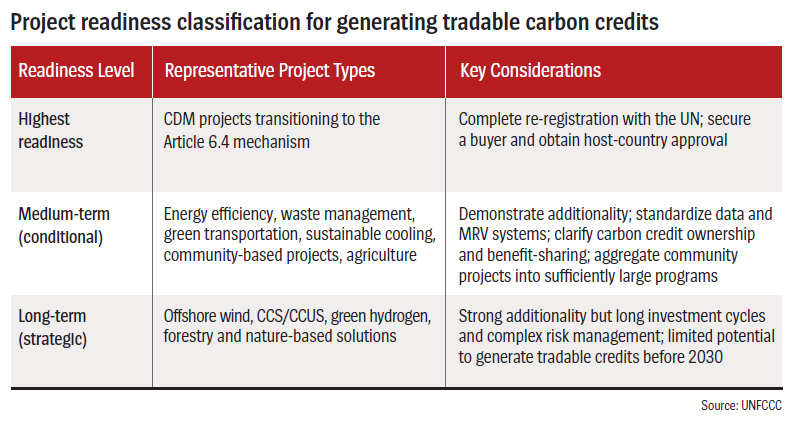
Decree No. 112 identifies two categories of projects eligible for international carbon transfers. These project types differ significantly in terms of opportunities, implementation barriers, and challenges. Based on their readiness to generate tradable carbon credits, they can be grouped as follows.
Projects transitioning from the CDM to the Article 6.4 mechanism are considered the most market-ready. Having established operational histories, technical documentation, and monitoring data, these projects are best positioned for early international transfers once buyers emerge and host-country approval is granted, provided they complete re-registration with the relevant UN body.
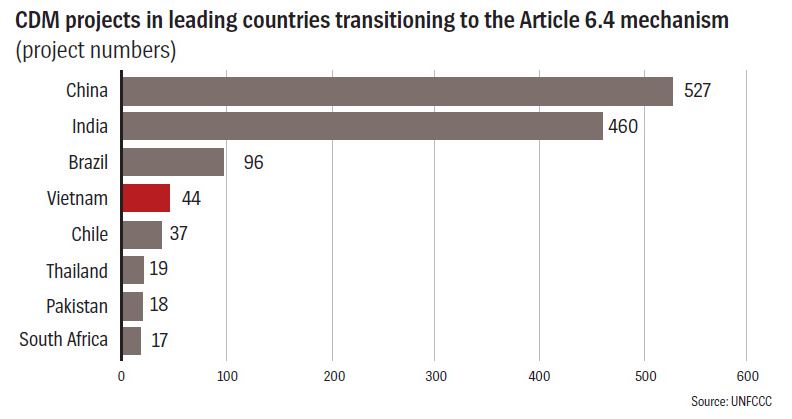
To date, 23 CDM projects have applied for transition to Article 6.4, including 15 renewable energy projects successfully supported by the Vietnam Energy and Environment Consultancy JSC (VNEEC).
In the medium term, energy efficiency, green transportation, and similar projects offer substantial potential but face significant challenges in demonstrating additionality. Energy efficiency and technology upgrading projects deliver dual benefits by reducing emissions while lowering operating costs. However, these direct financial gains make it more difficult to prove that carbon finance is essential for project implementation. Opportunities therefore exist primarily for projects that exceed prevailing market practices or regulatory requirements.
Waste management, sustainable cooling, community-based initiatives, and agricultural projects face their own challenges, including maintaining reliable operational data, demonstrating additionality, clarifying ownership of emissions reductions, and managing higher MRV costs when projects are implemented on a fragmented basis.
Over the longer term, advanced decarbonization technologies such as offshore wind, carbon capture and storage (CCS/CCUS), and green hydrogen demonstrate strong additionality because of their high capital requirements and limited commercial viability without carbon finance. However, lengthy development timelines and complex infrastructure requirements mean these projects are unlikely to generate tradable credits before 2030.
Forestry and nature-based solutions offer substantial carbon sequestration potential while delivering biodiversity and livelihood benefits. However, they also require robust risk management covering land tenure, permanence, and reversal risks. For these projects, the scale of emissions reductions alone is insufficient; strong governance and high-quality data will ultimately determine both the value and market attractiveness of the credits.
Five key risks
Though Decree No. 112 has established the legal framework, a considerable gap remains before projects can generate internationally-tradable carbon credits. The primary bottleneck is the ability to develop projects that are sufficiently mature from technical, legal, and financial perspectives.
The experience of CDM projects transitioning to Article 6.4 illustrates this challenge. Of Vietnam’s 175 registered CDM programs and projects, only 44 are eligible for such conversion, while just 23 have formally submitted transition applications.
Readiness is even lower among newly-proposed Article 6 projects, many of which remain at the conceptual stage, with estimated credit volumes based on preliminary assumptions rather than approved methodologies.
Carbon credits are not an automatic reward for every green investment. Rather, they are valuable assets that require rigorous preparation and management throughout a project’s lifecycle. Current constraints can be grouped into five major categories.
First, additionality risk. Projects may fail eligibility tests if they are already financially viable on their own, rely on widely adopted technologies, or fulfill mandatory regulatory requirements. Carbon project feasibility should therefore be assessed before investment decisions are made, particularly since many developers still lack the capacity to select appropriate methodologies, quantify emissions reductions, and evaluate carbon-related financial returns.
Second, data and MRV risk. Data quality remains a major weakness for many businesses. Without consistent, continuous, and reliable data collection from the outset, projects will struggle to demonstrate verified emissions reductions. Many companies also confuse corporate greenhouse gas inventories with the project-level MRV systems required for carbon credit generation. Errors or interruptions in operational data throughout the project lifecycle can significantly reduce the volume of credits ultimately issued.
Third, operational, production, and financial risk. Many project developers overestimate future carbon revenues while underestimating the costs of registration, validation, periodic MRV, credit issuance, and ongoing risk management. Experience from international projects implemented by the Investment and Trade Consultancy Co., Ltd. (INTRACO) shows that actual credit volumes are often affected by equipment performance, user behavior, feedstock quality, operating capacity, and data continuity. Companies should therefore avoid building financial projections based on peak carbon prices or committing to delivery volumes beyond realistic operating capacity.
Fourth, ownership and benefit-sharing risk. Projects involving multiple stakeholders, including landowners, farmers, technology providers, operators, and investors, must clearly define ownership of emission reductions and benefit-sharing arrangements from the outset. Failure to do so could create obstacles when raising finance, registering carbon credits, or negotiating with buyers.
Fifth, international transfer and regulatory risk. Under Decree No. 112, carbon credits or emission reductions become Internationally Transferred Mitigation Outcomes (ITMOs) only after receiving government approval for international transfer and undergoing corresponding adjustments. Depending on the project category, international transfers may be capped at either 90 per cent or 50 per cent, with the remaining portion retained to support Vietnam’s NDC commitments. Businesses must therefore account for the maximum transferable volume when evaluating the financial viability of carbon credit projects.
Article 6 credits from Vietnam are attracting growing interest from international buyers, though purchasing decisions have become increasingly cautious. As a result, many Vietnamese projects with strong emission reduction potential still struggle to secure financing or sign carbon credit purchase agreements.
UNDERSTANDING ARTICLE 6 CARBON PROJECTS
Carbon projects under Article 6 of the Paris Agreement reduce or remove greenhouse gas emissions, such as renewable energy, reforestation, or methane abatement, and are measured, reported, and verified to generate carbon credits that can be transferred internationally.
Article 6.2 allows countries to cooperate through bilateral or multilateral agreements and transfer emissions reductions internationally in the form of Internationally Transferred Mitigation Outcomes (ITMOs). To prevent double counting, the host country must apply a corresponding adjustment, meaning it cannot count the transferred emissions reductions toward its own Nationally Determined Contribution (NDC).
Article 6.4 establishes a UN-supervised carbon crediting mechanism that succeeds the Clean Development Mechanism (CDM), enabling both public and private entities to develop emissions reduction and carbon removal projects.
Compared with the voluntary carbon market, Article 6 projects are subject to stricter requirements for carbon accounting, the prevention of double counting, and host-country approval for international transfers. They must also satisfy the fundamental principle of additionality, demonstrating that the emission reductions would be unlikely to occur without revenue from carbon credits.
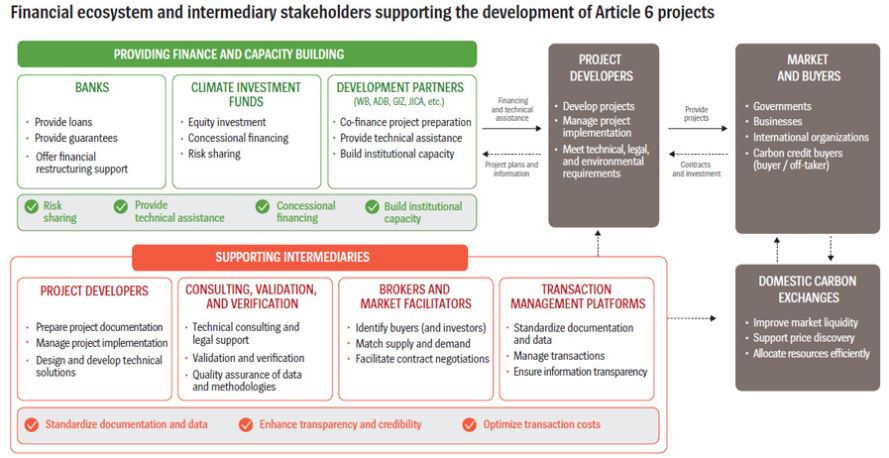
Closing this gap requires more than simply matching buyers with sellers. It requires a comprehensive financial and service ecosystem, including banks, climate investment funds, and development partners that share risks, co-finance project preparation, and provide concessional funding during the early stages. It also requires project developers, consultants, and brokers to connect project owners with the market, standardize documentation, and negotiate commercial agreements, while the domestic carbon exchange can enhance liquidity and improve price discovery. However, these mechanisms will be effective only if Vietnam can establish a stable pipeline of mature, high-quality projects capable of supplying the market.
Article 6 projects are not a shortcut to selling carbon credits at higher prices. Rather, they represent a new framework that places greater responsibility on businesses for data quality, project operations, legal compliance, and fulfillment of commercial commitments. Projects must also complete multiple stages before credits can be issued and transferred internationally.
Roadmap to ITMO success
ITMOs are market-based commodities whose value is determined by supply and demand. To convert emissions reduction potential into successful ITMO transactions, businesses should adopt a structured implementation roadmap.
First, define clear objectives and prioritize project portfolios. Companies should determine whether their primary goal is to reduce emissions to achieve internal net-zero targets, generate offset credits for emissions trading systems (ETS), or develop projects for the international carbon market. Carbon credit sales should not be viewed as standalone transactions but as part of a broader carbon strategy that balances internal climate commitments with commercial opportunities. Based on these objectives, businesses should identify projects offering the strongest combination of scale, additionality, manageable MRV costs, and acceptable legal risks.
Second, strengthen internal governance and data management. Carbon credit projects require close coordination across multiple business functions. Measurement and verification data must be fully aligned with operational records, energy invoices, and financial statements from the first day of project implementation through the entire crediting period.
Third, establish robust partnership and legal frameworks. For projects involving multiple stakeholders, contracts should clearly define carbon credit ownership, revenue-sharing arrangements, and responsibilities if actual credit issuance falls below expectations or international transfer approvals are delayed.
Fourth, take a strategic approach to buyers. Companies should prioritize buyers that offer risk-sharing mechanisms rather than simply the highest bid prices. Purchase agreements should incorporate realistic delivery schedules, adequate safety margins, and provisions to address legal uncertainties or delays in credit issuance.
Fifth, view international cooperation as more than a source of project financing. Effective project preparation requires sustained technical collaboration and institutional support. Experience from the Southeast Asia Energy Transition Partnership (ETP) in Vietnam, Indonesia, and the Philippines demonstrates that policy alignment and meaningful private sector participation cannot be achieved through isolated projects alone. The value of international cooperation should therefore be measured not only by the capital mobilized but also by stronger institutions, greater market confidence, and the ability of businesses to independently develop, implement, and commercialize carbon projects over the long term.
Opportunities in the international carbon market are expanding, while Vietnam has now opened the policy door. Whether projects can pass through that door, however, will depend on the quality of their preparation and the strength of their execution. Article 6 cannot transform projects with weak data, unreliable operating performance, or unclear ownership into high-quality carbon credits. International buyers are not simply purchasing a theoretical ton of avoided carbon dioxide emissions; they are investing in the credibility of an entire project - from its technology, data, and operations to its ability to issue and deliver credits as promised.
Businesses should therefore treat carbon credit projects as long-term investments and incorporate carbon considerations from the earliest stages of project development. Carbon credits should be managed as strategic assets, while commercialization should be viewed as a long-term commitment that spans the entire project lifecycle and requires strict compliance with quality, data, operational, and trading requirements.
VIETNAM’S COMPETITIVE ADVANTAGE IN THE INTERNATIONAL CARBON MARKET
Vietnam’s position in the international carbon market will not be determined by the number of projects it develops, but by the quality of its project portfolio. The most competitive projects are those in which carbon revenue provides genuine additional value to the underlying investment, emissions data can be reliably measured and verified, carbon credit ownership is transparent, and environmental and community co-benefits are clearly demonstrated.
Beyond corporate preparedness, Vietnam’s carbon market should prioritize projects with the highest level of readiness so that internationally-transferable credits can be issued as early as possible. These include CDM projects transitioning to the Article 6.4 mechanism, as well as mature bilateral carbon projects.
Pilot implementation of these projects will allow both regulators and businesses to test in practice the approval procedures and corresponding adjustment requirements established under Decree No. 112/2026/ND-CP. This will serve as an important proving ground for refining the regulatory framework, strengthening implementation capacity, and building confidence among international market participants.
(*) Dang Hong Hanh is from Vietnam Energy and Environment Consultancy JSC (VNEEC); Nguyen Hong Loan from Green Climate Innovation Company (GreenCIC); Hoang Anh Dung from Investment and Trade Consultancy Co. (INTRACO); and John Robert Cotton from Southeast Asian Energy Transition Partnership, United Nations Office for Project Services (ETP/UNOPS).




 Google translate