


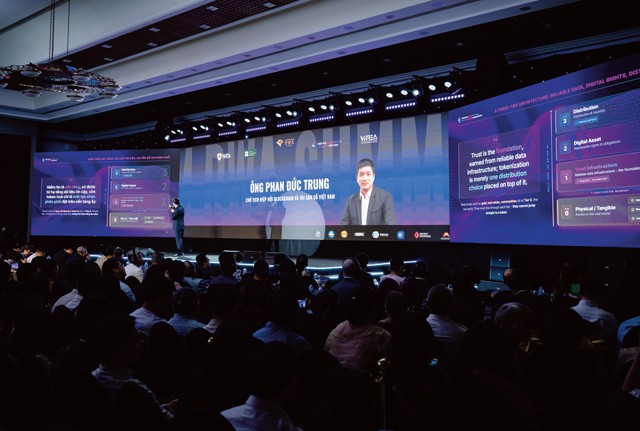
Around the world, bonds, investment funds, private credit, real estate, and other asset classes are gradually being tokenized and brought onto blockchain networks to improve operational efficiency, enhance transparency, and facilitate cross-border capital flows. As tokenized real-world assets (RWA) move into the financial mainstream, Vietnam is laying the groundwork to become an early mover in the emerging market.
Speaking at the Vietnam RWA Summit 2026, jointly organized by the State Securities Commission of Vietnam, the Vietnam Blockchain Association, the National Cybersecurity Association, and the Vietnam National Real Estate Association, experts said Vietnam is well positioned to capitalize on the global RWA wave thanks to three key advantages: an evolving regulatory framework, emerging blockchain infrastructure, and a large and active user base.
Reshaping financial markets
They noted that Vietnam is accelerating the development of its legal framework for digital assets. The Law on Digital Technology Industry, which took effect on January 1, 2026, is the country’s first legislation to formally recognize digital assets and crypto assets. In addition, Government Resolution No. 05/2025/NQ-CP on a pilot digital asset market establishes a foundation for issuance, trading, and licensing, paving the way for the development of RWAs. The Ministry of Finance is also finalizing accounting, taxation, and reporting regulations for digital assets.
Supporting infrastructure is also taking shape. The two international financial centers in Ho Chi Minh City and Da Nang are expected to provide testing grounds for fintech and digital asset initiatives. Meanwhile, the Vietnam Blockchain Service Network is being developed as a multi-chain platform incorporating a Vietnamese-developed Layer 1 blockchain designed to support large-scale digital asset transactions.
Mr. Phan Duc Trung, Chairman of the Vietnam Blockchain Association, said the essence of tokenized RWAs is the digitization of ownership rights to real economic assets into blockchain-based tokens.
Meanwhile, Dr. Can Van Luc, Chief Economist at the Bank for Investment and Development of Vietnam (BIDV) and Member of the National Financial and Monetary Policy Advisory Council, said RWA tokenization could create substantial value for financial markets if supported by an appropriate regulatory framework.
Tokenization can improve liquidity by enabling near-instant transactions while reducing intermediary costs. Assets can also be fractionally owned, lowering the investment threshold and expanding fundraising opportunities from both domestic and international investors. Blockchain technology enhances transparency, automates investor distributions, improves asset management, and creates opportunities for new financial products, helping promote financial inclusion.
However, Dr. Luc cautioned that RWAs also introduce significant risks that must be carefully managed, including legal and dispute resolution challenges, cybersecurity threats, price volatility, money laundering and terrorist financing, fraudulent token issuance without underlying assets, and risks related to valuation, settlement, and counterparties.
As tokenized assets become more widely traded, the market evolves beyond a simple asset marketplace into an integral part of the financial system, with potential implications for payment systems and financial stability. For that reason, Dr. Luc argued that a comprehensive, transparent regulatory framework supported by robust risk management mechanisms is essential for the sustainable development of the RWA market.
The biggest obstacle facing RWAs today is not blockchain technology but trust. “The capital market is fundamentally a market built on trust,” Mr. Trung said. “Whether you are raising capital or distributing assets, trust must come first. That requirement becomes even more important when capital markets operate on blockchain infrastructure.” He added that blockchain is simply the technology that enables the operation and distribution of assets. Market confidence must be built on the quality of the underlying data.
Citing research from the Bank for International Settlements, the International Organization of Securities Commissions, and the Organisation for Economic Co-operation and Development, Mr. Trung said digital capital markets require several core pillars: verified data on underlying assets, verifiable identities for market participants, mechanisms to validate claims relating to assets and cash flows, and transparent, continuous disclosure and oversight. Together, these elements determine whether assets can be trusted before they are tokenized.
Building reliable data infrastructure
Dr. Luc said international experience shows that countries generally follow one of two regulatory approaches to digital assets. Some have introduced dedicated legislation, while others have expanded existing legal frameworks, such as payment laws, securities laws, or financial regulations, to encompass digital asset activities.
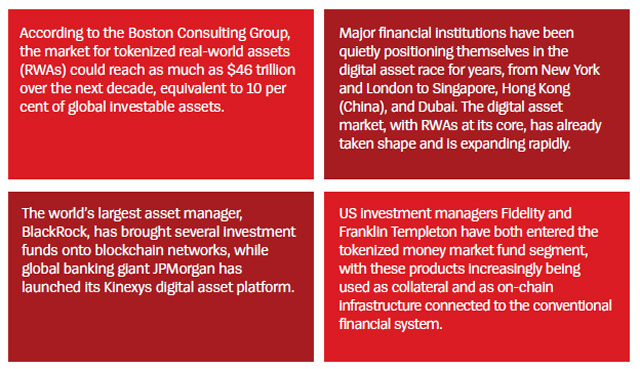
In Vietnam, Mr. Trung said the government has taken important steps to prepare for the development of the digital asset market, particularly through the creation of trusted data infrastructure.
The legal framework for digital identity and electronic authentication being developed by the Ministry of Public Security is expected to become a key foundation for identity verification and trust in digital transactions. “Vietnam has made remarkable progress in establishing a legal framework for digital assets within a relatively short period, with several important regulations already in place to support the development of the market,” Mr. Trung said.
Vietnam also benefits from strong market demand, with one of the world’s highest levels of digital asset adoption, providing a favorable foundation for integrating new digital financial infrastructure.
Nevertheless, experts believe Vietnam should adopt a phased approach to RWA development. The first priority should be establishing trusted data infrastructure capable of verifying assets, identities, and transactions. The next step is accelerating digital transformation across financial institutions and businesses to develop digital assets backed by real economic assets before expanding into a large-scale tokenization market.
Mr. Trung noted that capital inflows into RWAs increased by around 300 per cent in 2025, significantly outpacing most other digital asset categories. Yet the market has not developed as quickly as its potential would suggest because trust, not tokenization technology, remains the missing ingredient. Unlocking that potential will require close cooperation between regulators, issuers, market operators, and investors.
At the Vietnam RWA Summit 2026, Major General Dr. Ho Van Huong, Deputy Chief of the Government Cipher Committee, said that as Vietnam advances its national digital transformation, data, digital platforms, and information systems are becoming strategic assets for the government, businesses, and citizens alike. Protecting those digital assets is therefore not only a technical requirement but also a critical element of safeguarding digital sovereignty, maintaining national security, and strengthening trust in the digital economy.
He called for continued investment in data protection, identity authentication, encryption, cybersecurity monitoring, and digital trust infrastructure as the foundation for the safe and sustainable development of Vietnam’s digital economy and future digital financial markets.







 Google translate