


Despite global supply chain volatility and shifting trade dynamics, European business confidence in Vietnam surged to 79.7 points in the second quarter of 2026, according to the EuroCham Business Confidence Index (BCI) for Q2 2026, released on July 15. This momentum signals a renewed appetite among European investors for expansion in one of Southeast Asia’s fastest-growing economies, reaffirming the long-term confidence that briefly receded amid heightened global uncertainty.
“The first half of 2026 has been a rollercoaster,” said Mr. Bruno Jaspaert, Chairman of the European Chamber of Commerce (EuroCham). “We entered the year with complex geopolitical wildcards, yet despite a heavy cloud of global uncertainty, our member companies outperformed their own expectations. This Index proves that when the weather gets rough, our ecosystem knows how to recalibrate and capture growth.”
Bright spots
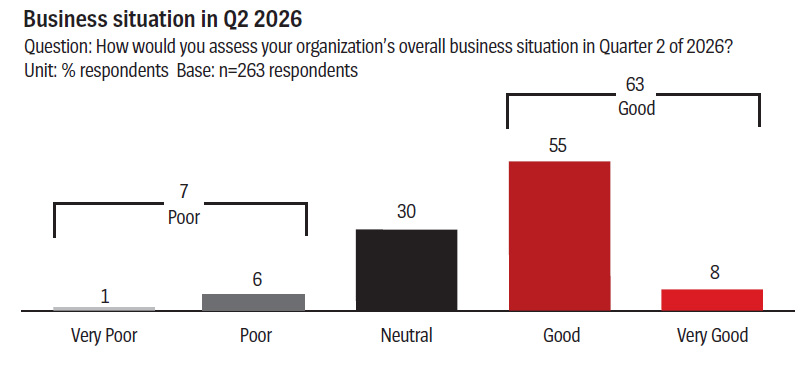
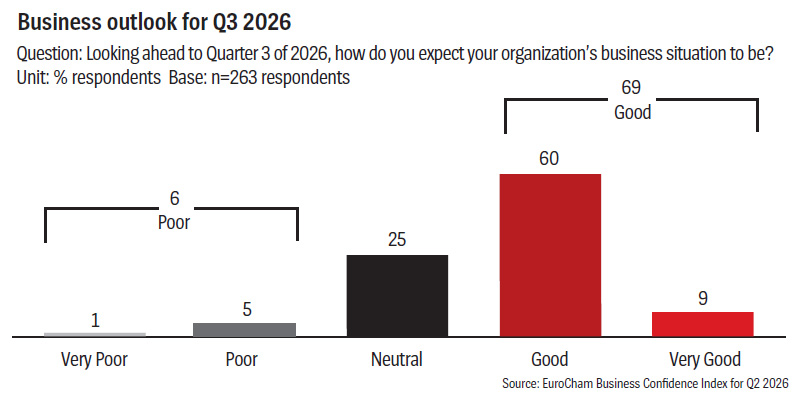
The survey revealed that 63 per cent of European businesses reported positive business conditions during the second quarter of the year, while optimism continues to strengthen, with 69 per cent expecting favorable conditions in the third quarter. This wave of optimism represents an 11 percentage point jump compared to expectations expressed just three months ago, driven by surging commercial performance, a healthy influx of new orders, and resilient domestic demand.
The data highlights clear commercial drivers behind this optimism. Among the firms reporting improved performance in the second quarter, 36 per cent pointed to rising revenues, stronger sales velocities, and enhanced operational profitability that consistently outpaced internal forecasts. Meanwhile, 32 per cent credited their brighter outlook to expanding order books and major new contract wins, while 24 per cent emphasized a noticeable strengthening in domestic consumer demand. “The trend of manufacturers continuing to shift to Vietnam from neighboring countries, along with the increasing allocation of customer production orders to Vietnam, has led to very strong revenue growth,” the report noted.
European businesses operating in Vietnam also benefit from the EU-Vietnam Free Trade Agreement (EVFTA). Among businesses engaged in Vietnam-EU trade, 50 per cent already benefit from the Agreement’s tariff preferences. For many, the impact is important: 32 per cent report that at least 20 per cent of their Vietnam-EU trade is covered by the deal, including 19 per cent where more than half is covered.
In addition, throughout this year, the government has accelerated institutional reforms, administrative restructuring, and investment policies aimed at attracting higher-quality FDI. Chief among these is the recent rollout of Politburo Resolution No. 10, which shifts the country’s FDI criteria away from cheap labor and raw volume toward high-tech innovation, technology, and sustainable growth. This balanced growth across manufacturing, tourism, real estate, and export-oriented sectors shows that Vietnam’s economic engine is accelerating on multiple cylinders.
Notably, the results also show European businesses continue to see Vietnam as one of Asia’s most promising investment destinations. More than half of the respondents (54 per cent) now describe Vietnam as a core strategic market and operational base, while a further 18 per cent consider it a major growth location. Together, these findings reflect a notable shift in how European companies position Vietnam within their regional and global business strategies. Rather than serving solely as a manufacturing base, Vietnam is increasingly seen as a platform for production, sourcing, regional services, and future expansion across Southeast Asia.
Mr. Jaspaert said that in the first half of 2026 alone, national GDP expanded by an impressive 8.18 per cent. “When you pair that breakneck growth with Vietnam’s rise to 27th in the IMD World Competitiveness Ranking and its upcoming FTSE Russell upgrade to a Secondary Emerging Market this September, the narrative is crystal clear,” he continued. “What makes Vietnam truly stand out in a fiercely-competitive regional landscape is a government that does not just talk about growth, but formalizes it into national resolutions and actively executes structural reforms to pursue it.”
Barriers in place
Despite the rising confidence, 53 per cent of businesses have consistently ranked regulatory delays, policy inconsistencies, and opaque tax administration not merely as minor daily annoyances but as the primary anchors dragging down their long-term expansion plans.
While these longstanding challenges remain firmly at the top of the business agenda, new pressures are also emerging. Talent shortages have continued to rise since the fourth quarter of 2025, now cited by 38 per cent of businesses and ranking among the three most pressing operational challenges. Meanwhile, technical and product standards have emerged as a growing source of operational complexity, reflecting the growing sophistication of Vietnam’s economy.
The impact extends well beyond regulatory compliance. One-third of businesses reported that administrative procedures slow operational execution and project delivery, while 29 per cent said they divert resources away from core business activities. A further 27 per cent believe regulatory complexity reduces competitiveness and limits market access.
Many respondents described spending an escalating amount of time dealing with licensing, repetitive approvals, and redundant documentation. This administrative burden acts as a stealth tax on innovation, limiting firms’ ability to reinvest capital into local R&D or facility expansions. Furthermore, businesses frequently pointed to the inconsistent implementation of central decrees across different authorities, unpredictable regulatory changes, and prolonged VAT refund procedures as persistent sources of financial uncertainty that tie up vital working capital.
Intellectual property (IP) protection also remains an important consideration for businesses, as Vietnam was named a Priority Foreign Country in the US’s April 2026 review, prompting a formal Section 301 investigation into its IP enforcement practices. Among respondents with registered IP or trademarks in Vietnam, 32 per cent reported experiencing at least one registration or enforcement challenge, most commonly weak dispute resolution mechanisms (28 per cent) and delays in administrative procedures (18 per cent), both of which can give foreign investors pause when looking to localize proprietary advanced technologies.
Global tensions also continue to weigh on businesses. Almost four in five businesses report being affected by events around the world in the second quarter of 2026, with 46 per cent reporting negative impacts and 33 per cent mixed impacts. Only 18 per cent report no impact and just 3 per cent identify an overall positive effect, indicating that exposure remains widespread despite improving business confidence.
These tensions continue to raise costs and disrupt supply chains. In particular, higher freight, shipping, and logistics costs were identified as the most significant consequence of global uncertainty, cited by 78 per cent of affected businesses, closely followed by higher energy and fuel costs (76 per cent).
Optimistic future
Taken together, there is a consistent message from the European business community: Vietnam’s economic fundamentals remain highly attractive, but administrative reform now represents the single greatest opportunity to strengthen competitiveness further. In addition, rather than waiting out the storm, businesses have responded by making their supply chains more resilient. Global disruptions also open up new opportunities. Some businesses quickly identified new opportunities arising from global supply chain shifts. Several respondents reported increased production orders and investment flows as manufacturers diversified operations toward Vietnam, reinforcing the country’s growing role as a regional manufacturing and sourcing hub.
Mr. Jaspaert told Vietnam Economic Times / VnEconomy that Vietnam’s ambition to achieve 10 per cent GDP growth is bold but entirely achievable, provided the country continues to accelerate institutional reforms, infrastructure development, and innovation. Vietnam is undertaking a unique transformation, he continued, by investing heavily in infrastructure while simultaneously pursuing rapid economic growth and attracting high-quality FDI.
The government’s focus on institutional reform, innovation, and private sector development is the correct strategy for unlocking the country’s next phase of growth. The European business community has also welcomed efforts to improve transparency and create a more consistent regulatory framework.
Vietnam possesses several unique advantages, including a young and highly-skilled workforce, an increasing number of internationally-educated professionals returning home, strong engineering capabilities, and ample fiscal space to invest in green infrastructure and transport networks. Several European companies have established their largest regional R&D centers or manufacturing facilities in Vietnam because they recognize the exceptional quality of Vietnamese engineers combined with attractive innovation incentives.
“Looking ahead, we are fully committed to ensuring that Vietnam’s ‘era of the nation’s rise’ is backed by the solid financial, physical, and legal infrastructure required to make it entirely sustainable, inclusive, and unstoppable,” Mr. Jaspaert said.




 Google translate