


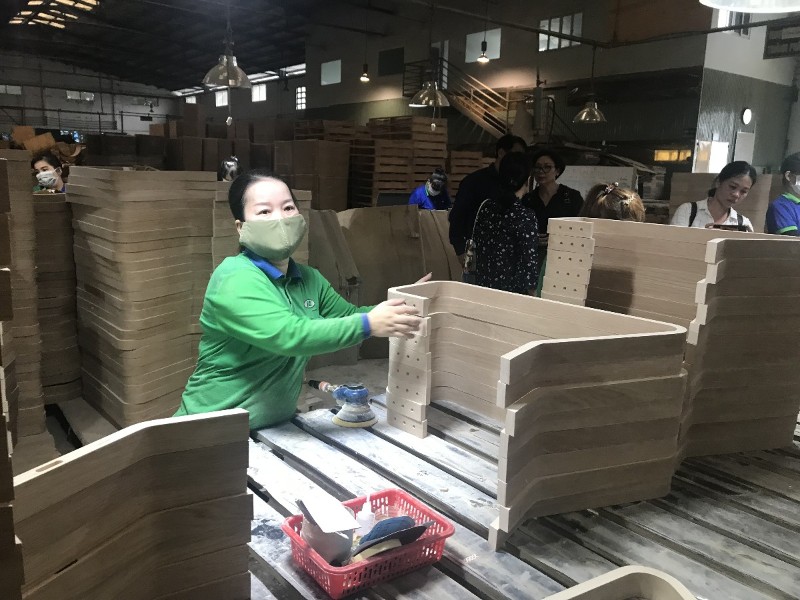
The Vietnam Timber and Forest Product Association (VIFOREST) has set an ambitious export target exceeding $18.5 billion for 2026.
To realize the goal, the industry plans to implement five core groups of solutions while simultaneously petitioning the Government to remove tax, credit, and administrative bottlenecks to create a more favorable environment for businesses.
First, the industry will focus on maintaining its presence in key traditional markets, with a particular emphasis on the United States.
Second, VIFOREST aims to diversify its export footprint by expanding into Japan, China, South Korea, the EU, India, Canada, Australia, the Middle East, and other emerging markets.
Third, the industry intends to effectively tap into the domestic market. By providing wooden furniture and materials for social housing projects, schools, hospitals, offices, hotels, and infrastructure developments, businesses aim to maintain production capacity, preserve jobs, and ensure steady cash flow.
Fourth, the sector will focus on enhancing value-added products. This involves developing products with superior design, established branding, and higher levels of deep processing. Additionally, the industry will utilize by-products to produce wood pellets, biomass, and other circular economy products.
Fifth, there will be a push for sustainable raw material development. This includes increasing the use of domestic plantation timber, certified wood, and legally imported timber.
The industry will also accelerate the digitalization of traceability records to meet EU Deforestation Regulation (EUDR) requirements and strengthen linkages with forest owners and cooperatives to transition toward large-timber forestry.
Recommendations for Government support
To ensure these solutions are effective, VIFOREST has requested that the Ministry of Agriculture and Environment, along with other central agencies, focus on five areas of support.
First, establish a regular exchange mechanism with US agencies and associations to provide transparent information regarding labor, the environment, and Vietnam’s plantation materials. This aims to protect the legitimate interests of Vietnamese businesses against tax measures and trade defense investigations.
Second, the Association proposes abolishing the 25% export tax on sawn timber produced from imported roundwood and the 5% export tax on black pellets and sawdust charcoal. VIFOREST estimates that resolving these tax issues could boost annual export turnover by $500–700 million.
Third, VIFOREST suggests creating tailored credit packages for wood processing enterprises and forest owners. Furthermore, it recommends restructuring debt repayment schedules for businesses significantly impacted by the tax policies of major international markets.
Fourth, increase resources for trade promotion, supporting businesses in attending international fairs and connecting with global distribution networks. This includes promoting the national brand: "Legal, Sustainable, and Responsible Vietnamese Wood."
Fifth, the Association calls for the continued digitalization and integration of procedures for planting area identification, CITES licensing, and origin certification. They also recommend the "single-declaration" use of data to eliminate duplicate inspections and shorten customs clearance times.






 Google translate