


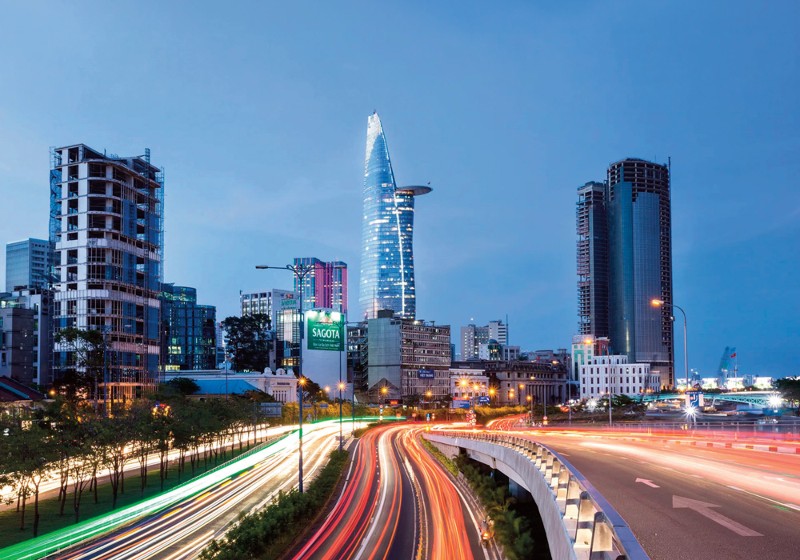
Ho Chi Minh City has been positioning itself not only as a destination for high-quality FDI but also as an architect of a new development ecosystem that will underpin its role as Vietnam’s economic growth engine in the country’s next phase of development. Amid a sweeping restructuring of global supply chains, the southern city is shifting its FDI strategy from prioritizing investment volumes to improving the quality of incoming capital.
Rather than focusing solely on attracting investment projects, Ho Chi Minh City is seeking to develop a sustainable investment ecosystem driven by innovation and technology transfer. The strategy aims to strengthen the city’s competitiveness while reinforcing Vietnam’s position on the global investment map.
Building a sustainable ecosystem
According to Mr. Nguyen Van Duoc, Deputy Secretary of the Ho Chi Minh City Party Committee and Chairman of the People’s Committee, Politburo Resolution No. 10-NQ/TW on the development of the foreign-invested sector is strategically significant for Vietnam’s next stage of development, reflecting a fundamental shift in the country’s approach to foreign-invested enterprises (FIEs).
As global supply chains continue to be reconfigured, the city is fundamentally reshaping its investment attraction strategy by prioritizing projects with advanced technology, high added value, R&D capabilities, technology transfer, and the potential to create spillover benefits for domestic enterprises.
While previous efforts focused primarily on attracting capital, the emphasis has now shifted to improving investment quality and efficiency, using innovation, technology transfer, and national competitiveness as key benchmarks. The strategy marks a transition from attracting capital to attracting knowledge, technology, and management expertise.
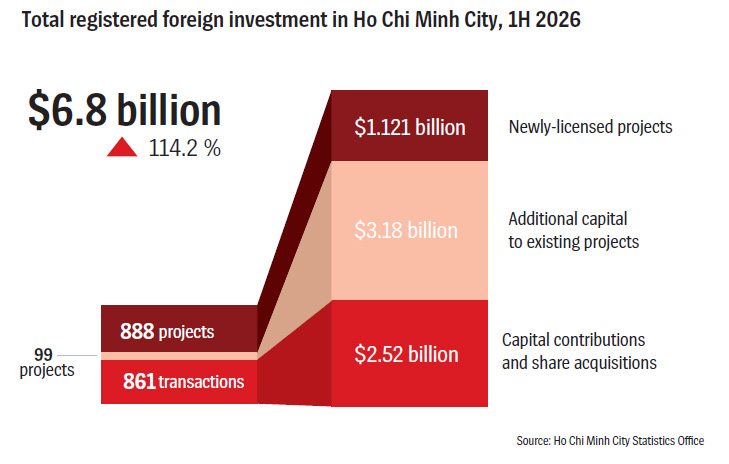
As of mid-2026, Ho Chi Minh City had 20,259 active FDI projects from 152 countries and territories with total registered capital of nearly $142 billion. It attracted more than $6.8 billion in FDI during the first half, or more than double the figure posted in the first half of last year and representing some 62 per cent of its annual target.
The FDI sector currently accounts for around 20 per cent of the city’s total social investment and more than 50 per cent of its export turnover. The figures reflect a clear shift in capital flows toward high technology, financial services, AI, semiconductors, logistics, and R&D, while supporting the development of strategic technology clusters that will enable Ho Chi Minh City to move further up global value chains.
A key component of the city’s next-generation FDI strategy is the planned Strategic Technology Development Center within Saigon Hi-Tech Park. The project will act not only as a manufacturing and testing base for advanced technologies but also as a hub for data infrastructure, AI, research, training, and technology incubation. Covering nearly 53 ha, the Center is expected to become a focal point connecting manufacturing, research, education, and technology startups, while attracting leading technology companies such as Intel, Qualcomm, NVIDIA, Marvell, and Axon.
Ho Chi Minh City has also identified the Vietnam International Financial Center in Ho Chi Minh City (VIFC-HCMC) as another strategic pillar for attracting high-quality FDI. The Center is expected to bring together financial institutions, investment banks, and global investment funds while facilitating the transfer of management expertise, transparency standards, data, international talent, and global financial networks. The initiative is intended to position the city not only as a destination for high-quality investment but also as an emerging regional hub for finance, technology, and innovation.
Three priorities
In recent years, global FDI has declined in overall volume while becoming increasingly selective. Investment has continued to flow into high-technology industries, green finance, the digital economy, semiconductors, AI, clean energy, and innovation.
Investors are also no longer seeking the lowest-cost locations. Rather, they are prioritizing economies with transparent institutions, developed capital markets, a highly-skilled workforce, strong asset protection, dynamic innovation ecosystems, and close links to international financial networks.
According to Mr. Duoc, Ho Chi Minh City is not only attracting high-quality FDI but is also steadily building a new development ecosystem that will reinforce its role as Vietnam’s leading growth engine in the years ahead. The new direction established under Politburo Resolution No. 10 is already reshaping the investment strategies and capital allocation of FIEs in Vietnam, encouraging investors to deepen existing operations rather than simply increase investment volumes.
To capitalize on these trends, the city has proposed three strategic priorities. The first is to shift from a project-based investment attraction model to one focused on building an integrated investment ecosystem, with priority sectors including high technology, AI, semiconductors, the digital economy, green finance, clean energy, and innovation.
The second is to develop the VIFC as a strategic institution capable of mobilizing and allocating investment capital more effectively. Ho Chi Minh City alone needs to mobilize more than VND1,000 trillion ($38.5 billion) in total social investment in 2026, including approximately $7.8 billion from foreign investors, to achieve its target of double-digit economic growth. Meeting this objective will require a modern financial institution capable of attracting, allocating, and directing international capital flows.
The third is the city’s commitment to take the lead in establishing the VIFC in line with directions from the Politburo, the National Assembly, and the government, creating a gateway through which localities, businesses, and key economic sectors can gain more effective access to international capital.
Laying the foundation
The city’s evolving FDI strategy reflects a broader shift toward a more innovation-driven growth model. Prioritizing high-tech investment, developing the VIFC, expanding the Saigon Hi-Tech Park, and introducing dedicated policy mechanisms are expected to provide the foundation for a regionally-competitive investment ecosystem.
More importantly, next-generation FDI brings far more than just capital. It also delivers advanced technology, management expertise, research networks, international standards, and highly-skilled talent. These capabilities will help Vietnamese enterprises integrate more deeply into global value chains while strengthening the competitiveness of the national economy.
As multinational corporations continue to restructure their investment networks and search for new technology hubs across Asia, Ho Chi Minh City is well positioned to capture the next wave of high-quality FDI. As its institutions, infrastructure, workforce, and innovation ecosystem continue to improve, international investment is expected to play a central role in driving economic growth and supporting the city’s ambition to become a leading regional center for finance, technology, and innovation.
 Google translate