


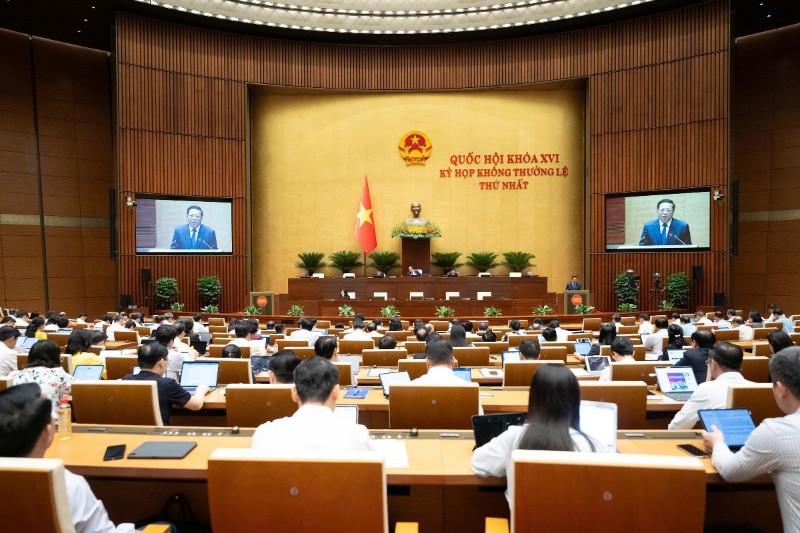
At the first extraordinary session of the 16th National Assembly on August 6, Minister of Construction Tran Hong Minh, authorized by the Prime Minister, presented a proposal from the Government for an investment policy for a project to construct the Hanoi Capital Region’s Ring Road 5.
The minister emphasized that timely investment in the project is essential to complete the regional transport network and lower logistics costs.
The proposed Ring Road 5 will span approximately 349 km, passing through seven provinces and cities. The main route is designed to expressway standards with six lanes and a design speed of 100–120 km/h, while parallel roads will have a minimum of two lanes and a design speed of 60–80 km/h. Minister Minh noted that the proposed route has already received written consensus from all seven localities involved.
According to preliminary plans, the project requires the reclamation of approximately 4,011 ha of land, with compensation, support, and resettlement costs estimated at VND78.143 trillion (nearly $3 billion).
The total preliminary investment for the project is roughly VND288.27 trillion ($11 billion). Of this, the central budget will contribute over VND215.19 trillion (nearly $8.2 billion) for the main expressway, while VND73.076 trillion ($2.78 billion) for the parallel roads will be financed by local provincial budgets.
The investment strategy involves preparing the entire route in the initial stage to facilitate capital mobilization. In the immediate future, the project will focus on constructing 116 km of the eastern section, stretching from Thai Ha Bridge to the Bac Giang – Lang Son Expressway. This segment is identified as having high transport demand and significant potential for urban, industrial, and logistics development. Resources will continue to be mobilized for the remaining sections, with a goal of completing the entire 349-km ring road before 2035.
Reviewing the proposal, Mr. Phan Van Mai, Chairman of the National Assembly Economics and Finance Committee, requested that the Government further review and harmonize data across project documents. Specifically, the Government was urged to clarify the scope of land reclamation, the number of affected households, resettlement needs, and impacts on vulnerable groups to ensure a comprehensive dossier.
Regarding funding, the committee called on the Government to clarify the capital structure and disbursement schedules for both central and local budgets, particularly for localities expected to provide substantial funding such as Hanoi and Hai Phong. Additionally, the committee requested formal commitments from all seven localities regarding their capacity to fund parallel roads and manage compensation and resettlement tasks.








 Google translate